Advertisements
Advertisements
Question
Explain the concept of IVF.
Advertisements
Solution
- IVF stands for In Vitro Fertilization.
- It is a modern medical technique that helps childless couples have their own biological child.
- IVF is used when couples face problems such as low sperm count, blocked oviducts (fallopian tubes), or other fertility issues.
- In this technique, an ovum (oocyte) is collected from the mother and fertilized with sperm collected from the father outside the body in a laboratory.
- Since fertilization takes place in a test tube or culture dish, IVF is commonly known as the test-tube baby technique.
- The embryo formed is then implanted into the uterus of the biological mother or a surrogate mother at the appropriate stage for further development.
APPEARS IN
RELATED QUESTIONS
Why does menstruation occur?
Describe the development of a fertilized ovum upto implantation.
What is hymne?
Name the two types of twins.
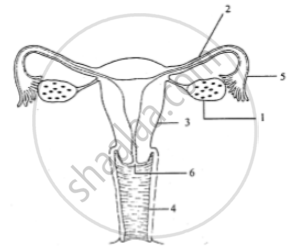
The diagram given below represents a system in the human body. Study the diagram and answer the following questions:
- Identify the system.
- Label the parts marked 5 and 6.
- Name the two hormones secreted by 1.
- Mention the number and the name of the part involved in fertilization and implantation from the above diagram.
- Mention the surgical methods of contraception in:
- Human males.
- Human females.
The below diagram represents the vertical view of the human female reproductive system.
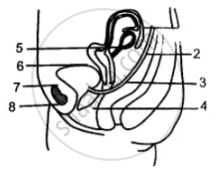
(i) Label the parts indicated by the guidelines 1 to 8.
(ii) How does the uterus prepare for the reception of a zygote?
(iii) What happens to the uterus if fertilization takes place?
(iv) What happens to the uterus if fertilization has failed to take place?
Give Technical Term:
What term is used for the production and maturation of eggs in the ovaries?
Write the functional activity of the following structure:
Ovary
The largest cell in the human body of a female is ______.
Which of the following is/are included in the external genitalia of the female reproductive system?
Which one the following is a part of external genitalia of a female human being?
The finger-like projections, called fimbriae, help in the collection of ovum into the fallopian tube following ovulation.
The embryo in humans gets nutrition from the mother’s blood with the help of a special tissue called ______
Read the following and answer from given below:
During copulation, semen is released by the penis into the vegina. The motile sperms swim rapidly, fuse with the ovum in the ampullary region, resulting in fertilization. The haploid nucleus of sperm fuses with that of the ovum to form a diploid zygote.
Select the correct sequence of various physical and chemical events that take place during fertilisation.
P. Fusion of cortical granules with the plasma membrane of secondary oocyte.
Q. Formation of fertilization cone to receive sperm.
R. Release of sperm lysin from acrosome.
S. Mixing up of chromosomes of a sperm and an ovum.
Which is a pear-shaped muscular organ in females?
Write the specific location of the following:
Uterus
Write the specific location of the following:
Vagina
From where does each fallopian tube extend?
After puberty, how often do the ovaries release one ovum?
