Advertisements
Advertisements
Question
Explain with examples types of asexual reproduction in unicellular organisms.
Advertisements
Solution
Asexual reproduction occurs in unicellular organisms through various methods. Some of these methods are as follows:
- Binary Fission: In this method, the parent cell divides into two equal parts, resulting in the formation of two new daughter cells. This division occurs through mitotic division. Generally, binary fission occurs in favourable conditions when sufficient food is available. Bacteria, protozoa, mitochondria, and chloroplasts reproduce asexually through binary fission.
Depending on the axis of division, binary fission in different protozoa is classified as:- Simple Binary Fission: Since Amoeba does not have a definite shape, it can divide along any axis. Therefore, this type of fission is called simple binary fission.
Example: Amoeba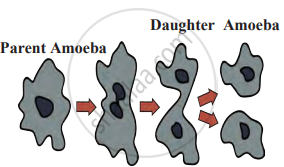
- Transverse (Horizontal) Binary Fission: In Paramecium, division occurs along the transverse axis.
Example: Paramecium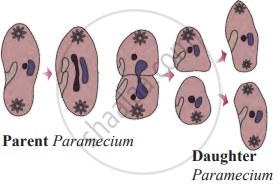
- Longitudinal (Vertical) Binary Fission: In Euglena, division occurs along the longitudinal axis.
Example: Euglena
- Simple Binary Fission: Since Amoeba does not have a definite shape, it can divide along any axis. Therefore, this type of fission is called simple binary fission.
- Multiple Fission: Amoeba and similar unicellular protozoa reproduce asexually through multiple fission in unfavourable conditions. When food is insufficient or environmental conditions become unfavourable, Amoeba stops moving and does not produce pseudopodia. It becomes spherical and forms a hard protective covering around itself, known as a “Cyst”.
Inside the cyst, the nucleus undergoes multiple mitotic divisions, resulting in the formation of several nuclei. Later, the cytoplasm also divides, producing multiple small Amoebae. These remain inside the cyst until favourable conditions return. Once conditions improve, the cyst bursts, releasing several young Amoebae.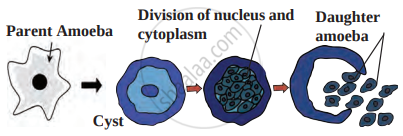
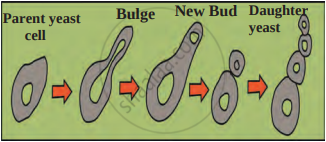
- Budding: Yeast reproduces asexually through budding. First, mitotic division occurs in the parent cell, producing two daughter nuclei. A small outgrowth, called a "Bud", appears on the parent cell. One of the daughter nuclei enters this bud. After growing sufficiently, the bud detaches from the parent cell and starts developing as an independent yeast cell.
RELATED QUESTIONS
State the function of Ovary.
Fill in the blank:
The time between fertilisation and birth is called _________.
Rewrite the terms in the correct order so as to be in a logical sequence.
Graafian follicle, ostium, uterus, fallopian tube.
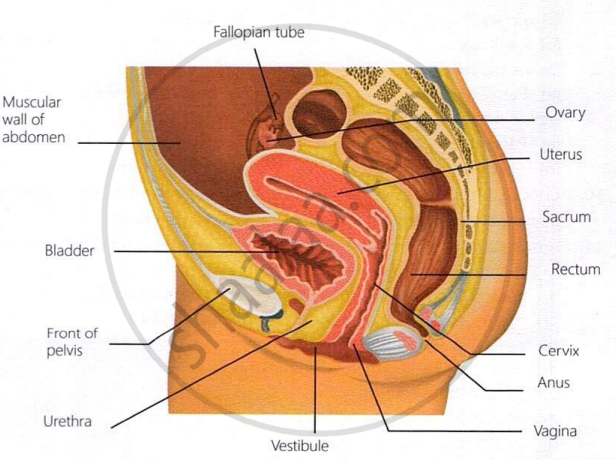
The diagram alongside is the vertical section of female reproductive organs. Study the diagram and answer the questions that follow:
- Name the fully developed part of ovary containing the ovum.
- Name the organ of the female body in which the foetus develops.
- What is ovulation?
- Which two hormones are secreted by ovary?
Complete the following statement by choosing the correct alternative:
Female copulatory organ ______.
Give Reasons
Most often only one embryo is formed at a time although there are two ovaries in women. Explain.
Mention, if the following statement is True or False. If false rewrite the wrong statement in its correct form:
The cilia lining the oviduct funnel, push the released ovum into the uterus.
Generally, every month, __________ ovum is released in the abdominal cavity alternately from each ovary.
State names of organs in the female reproductive system.
Identify the labels (i, ii and iii) in the given diagram of the female reproductive system.
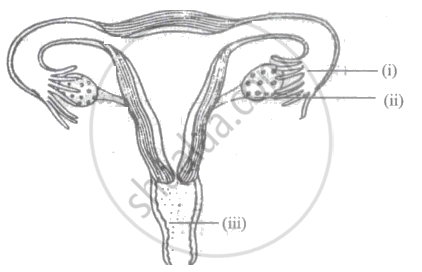
The part of fallopian tube closest to the ovary is ______.
Identify the odd one from the following.
Bartholin’s glands are situated ______.
In oocyte secondary maturation occurs in ______.
To answer the question, study the graphs below for Subjects 1 and 2 showing different levels of certain hormones.
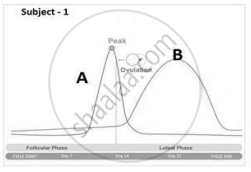
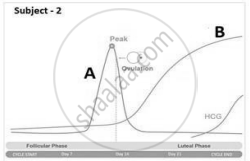
If the peak of Hormone A does not appear in the study for Subject 1, which of the following statement is true?
The embryo in humans gets nutrition from the mother’s blood with the help of a special tissue called ______
Which among the following is not the function of testes at puberty?
- formation of germ cells
- secretion of testosterone
- development of placenta
- secretion of estrogen
What changes are observed in the uterus if fertilisation does not occur?
The diagram given below shows a section of the human ovary.
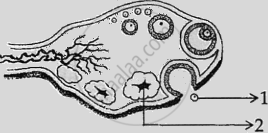
- Name the process for the release of the part labelled 1.
- Write the name of the structure marked 2.
Choose the odd one out from the group of terms given below and write the category for the remaining terms:
