Advertisements
Advertisements
प्रश्न
Explain with examples types of asexual reproduction in unicellular organisms.
Advertisements
उत्तर
Asexual reproduction occurs in unicellular organisms through various methods. Some of these methods are as follows:
- Binary Fission: In this method, the parent cell divides into two equal parts, resulting in the formation of two new daughter cells. This division occurs through mitotic division. Generally, binary fission occurs in favourable conditions when sufficient food is available. Bacteria, protozoa, mitochondria, and chloroplasts reproduce asexually through binary fission.
Depending on the axis of division, binary fission in different protozoa is classified as:- Simple Binary Fission: Since Amoeba does not have a definite shape, it can divide along any axis. Therefore, this type of fission is called simple binary fission.
Example: Amoeba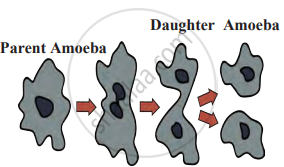
- Transverse (Horizontal) Binary Fission: In Paramecium, division occurs along the transverse axis.
Example: Paramecium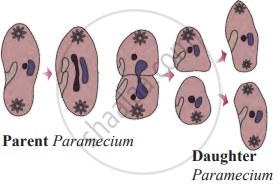
- Longitudinal (Vertical) Binary Fission: In Euglena, division occurs along the longitudinal axis.
Example: Euglena
- Simple Binary Fission: Since Amoeba does not have a definite shape, it can divide along any axis. Therefore, this type of fission is called simple binary fission.
- Multiple Fission: Amoeba and similar unicellular protozoa reproduce asexually through multiple fission in unfavourable conditions. When food is insufficient or environmental conditions become unfavourable, Amoeba stops moving and does not produce pseudopodia. It becomes spherical and forms a hard protective covering around itself, known as a “Cyst”.
Inside the cyst, the nucleus undergoes multiple mitotic divisions, resulting in the formation of several nuclei. Later, the cytoplasm also divides, producing multiple small Amoebae. These remain inside the cyst until favourable conditions return. Once conditions improve, the cyst bursts, releasing several young Amoebae.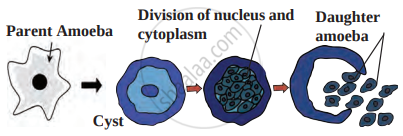
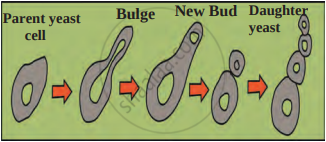
- Budding: Yeast reproduces asexually through budding. First, mitotic division occurs in the parent cell, producing two daughter nuclei. A small outgrowth, called a "Bud", appears on the parent cell. One of the daughter nuclei enters this bud. After growing sufficiently, the bud detaches from the parent cell and starts developing as an independent yeast cell.
संबंधित प्रश्न
Draw a labelled diagram of the female reproductive system.
Write two major functions of ovary.
Name the function of the following:
Fimbriae
Rewrite the terms in the correct order so as to be in a logical sequence.
Puberty, menopause, menstruals, menarche, reproductive age.
The following diagram represents the vertical sectional view of the human female reproductive system.
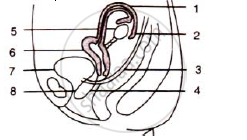
Label the parts indicated by the guidelines 1 to 8.
Give appropriate term of the following:
The process of fusion of ovum and sperm.
Name the following:
The parts of the ovary containing mature ovum.
Give Technical Term:
What term is used for the production and maturation of eggs in the ovaries?
Write the functional activity of the following structure:
Fallopian tubes
The pair of thin folds present inner to the labia majora is ____________.
______ is homologous to Bartholin's glands.
Which of the following is ectodermal in origin?
| (i) | Heart |
| (ii) | Sweat glands |
| (iii) | Adrenal medulla |
| (iv) | Middle ear |
| (v) | Urinary bladder |
| (vi) | Dermis of skin |
Egg is liberated from ovary in ______.
To produce 400 seeds, the number of meiotic divisions required will be ______
Read the following and answer from given below:
Oogenesis is the process of the formation of an ovum in the ovaries. It consists of three phases: multiplication, growth, and maturation. Oogenesis is controlled by hormones GnRH, LH, FSH. GnRH secreted by the hypothalamus stimulates the anterior lobe of the pituitary gland to secrete LH and FSH.
Which hormone induces the rupture of the mature Graafian follicle?
Which among the following is not the function of testes at puberty?
- formation of germ cells
- secretion of testosterone
- development of placenta
- secretion of estrogen
Capacitation occurs in:
The oviducts are also known as ______.
Give reason:
Uterine lining becomes thick and spongy after fertilisation.
Which part of the fallopian tube is the wider, curved middle section and the site of fertilisation?
