Advertisements
Advertisements
प्रश्न
Generally, every month, __________ ovum is released in the abdominal cavity alternately from each ovary.
पर्याय
1
2
3
4
Advertisements
उत्तर
Generally, every month, 1 ovum is released in the abdominal cavity alternately from each ovary.
APPEARS IN
संबंधित प्रश्न
Fill in the blank:
Lower part of uterus is called _________.
Differentiate between the following pair:
Uterus and vegina
Differentiate between:
Implantation and pregnancy
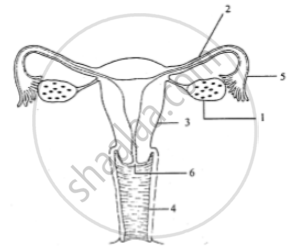
The diagram given below represents a system in the human body. Study the diagram and answer the following questions:
- Identify the system.
- Label the parts marked 5 and 6.
- Name the two hormones secreted by 1.
- Mention the number and the name of the part involved in fertilization and implantation from the above diagram.
- Mention the surgical methods of contraception in:
- Human males.
- Human females.
Name the following:
The parts of the ovary containing mature ovum.
Name the Following
The term used when beard and mustache appear, harshening of voice, broadening of shoulders, etc. takes place.
Which one the following is a part of external genitalia of a female human being?
To produce 400 seeds, the number of meiotic divisions required will be ______
The fertilization of the human egg by the sperm takes place in ______
Which among the following is not the function of testes at puberty?
- formation of germ cells
- secretion of testosterone
- development of placenta
- secretion of estrogen
What changes are observed in the uterus subsequent to the implantation of a young embryo?
The oviducts are also known as ______.
Draw a neat diagram of the female reproductive system and label the parts associated with the following:
(a) production of gamete
(b) site of fertilisation
(c) site of implantation
(d) birth canal
With a suitable diagram, describe the organisation of mammary gland.
Which part of the female reproductive system is paired incorrectly with its function?
Which part of the fallopian tube is closest to the ovary and has finger-like fimbriae at its edges?
Which uterine layer is the external thin membranous protective outer covering?
What connects the embryo to the mother for nutrient and waste exchange till birth?
At what age does puberty begin in females?
