Advertisements
Advertisements
प्रश्न
Explain the concept of IVF.
Advertisements
उत्तर
- IVF stands for In Vitro Fertilization.
- It is a modern medical technique that helps childless couples have their own biological child.
- IVF is used when couples face problems such as low sperm count, blocked oviducts (fallopian tubes), or other fertility issues.
- In this technique, an ovum (oocyte) is collected from the mother and fertilized with sperm collected from the father outside the body in a laboratory.
- Since fertilization takes place in a test tube or culture dish, IVF is commonly known as the test-tube baby technique.
- The embryo formed is then implanted into the uterus of the biological mother or a surrogate mother at the appropriate stage for further development.
APPEARS IN
संबंधित प्रश्न
State the function of Fallopian tubes.
Which part of the human body produces Ova?
Choose the odd one in each of the following:
Ovary; fallopian tube; ureter; uterus
Differentiate between the graafian follicle and corpus luteum.
Name the Following
Surgical operation of the fallopian tubes in females for family planning.
Mention, if the following statement is True or False. If false rewrite the wrong statement in its correct form:
The cilia lining the oviduct funnel, push the released ovum into the uterus.
Observe the diagram and answer the following questions.
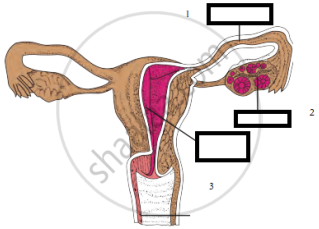
- Label the indicated parts 1, 2 and 3 in the diagram.
- Where the fertilization of ovum occurs?
- Where does the embryo get implanted after fertilization?
Development of mammary glands is controlled by ____________.
Primordial follicle cells undergo mitotic division to produce ______.
Which part of ovary in mammals acts as an endocrine gland after ovulation?
Lower narrow end of uterus is called ______.
The finger-like projections, called fimbriae, help in the collection of ovum into the fallopian tube following ovulation.
To answer the question, study the graphs below for Subjects 1 and 2 showing different levels of certain hormones.
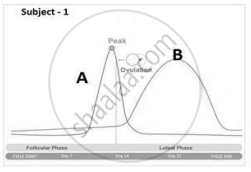
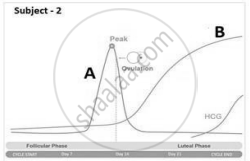
Which of the following statements is true about the subjects?
Fertilization occurs in human females when the sperms and ovum reach simultaneously at ______
How can we say that fish exhibits external fertilisation?
What is the other name for fallopian tubes?
Which hormone facilitates contraction of fallopian tube and uterus to assist movement of sperms towards ampulla?
Which organs are the primary sex organs of the female reproductive system?
What are the clusters of milk-secreting cells within mammary lobes called?
