Advertisements
Advertisements
Question
The below diagram represents the vertical view of the human female reproductive system.
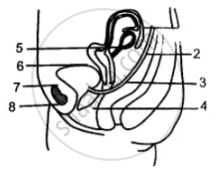
(i) Label the parts indicated by the guidelines 1 to 8.
(ii) How does the uterus prepare for the reception of a zygote?
(iii) What happens to the uterus if fertilization takes place?
(iv) What happens to the uterus if fertilization has failed to take place?
Advertisements
Solution
(i)
1. Oviduct
2. Funnel of oviduct
3. Ureter
4. Vagina
5. Ovary
6. Uterus
7. Bladder
8. Urethra
(ii) The endometrium lining and glands of the uterine wall grow to prepare the uterus for the reception of a zygote.
(iii) If fertilization takes place, the embryo is implanted in the uterus. The uterus wall develops a placenta which attaches the embryo to the uterus and the uterine wall expands to accommodate the growing embryo.
(iv) If fertilization fails to take place, menstruation takes place during which endometrium of the uterus is cast off. The capillaries and cells of this layer rupture and disappear.
APPEARS IN
RELATED QUESTIONS
Mention the functions of Uterus in the human female reproductive system.
The diagram given below represents a system in the human body. Stud the diagram and answer the following questions: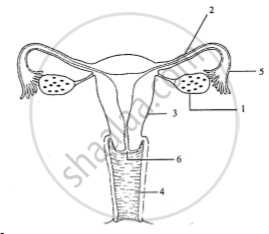
Name the two hormones secreted by 1.
The diagram given below represents a system in the human body. Stud the diagram and answer the following questions: 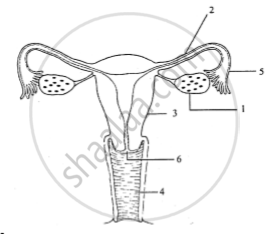
Mention the number and the name of the part involved in fertilization and implantation from the above diagram.
Draw a sectional view of the human ovary. Label the following parts :
(ii) Secondary oocyte
(iii) Graafian follicle
(iv) Corpus luteum
Name the Following
A cellular sac containing maturing egg.
Generally, every month, __________ ovum is released in the abdominal cavity alternately from each ovary.
Name the part of the human female reproductive system where the following occurs.
Fertilization
Penis is homologous to ____________.
In absence of fertilization, corpus luteum degenerates into ______.
Choose the odd one out from the group of terms given below and write the category for the remaining terms:
