Advertisements
Advertisements
Question
Name the function of the following:
Fimbriae
Advertisements
Solution
They are finger-like projections at the ovarian end of the fallopian tube. They help in the collection of the ovum (after ovulation), which is facilitated by the beating of the cilia.
APPEARS IN
RELATED QUESTIONS
Where in the fallopian tube does fertilization occur in humans?
Explain with examples types of asexual reproduction in unicellular organisms.
Give the names.
Hormones secreted by the ovary of the female reproductive system.
Give appropriate term of the following:
The monthly discharge of blood and disintegrated uterine tissues in human female.
Name the following:
The part of the female reproductive system in which fertilization occurs.
Name the following:
Organ producing ovum.
Complete the following statement by choosing the correct alternative:
Female copulatory organ ______.
Give the functions of the following:
Penis
Give Reasons
Most often only one embryo is formed at a time although there are two ovaries in women. Explain.
Name the Following
The female copulatory organ in humans.
Name the Following
A cellular sac containing maturing egg.
Give Technical Term:
What term is used for the arrest of reproductive capacity in females?
Identify the term used for isthmus.
Identify the distal narrow part of the duct opening into the uterus.
All are internal genitalia in females. EXCEPT ______.
The development of lactiferous tubules during pregnancy is dependent on ____________.
During which process is the egg released from the Graafian follicle?
After birth, colostrum is released from mammary glands which is rich in ______.
The finger-like projections, called fimbriae, help in the collection of ovum into the fallopian tube following ovulation.
Endometrium undergoes cyclical changes and help in uterine movements.
Mark the odd one.
What is placenta? Mention its role during pregnancy?
Anterior lobe of pituitary secretes:
Female reproductive organs and associated functions are given below in column A and B. Fill the blank boxes.
| Column A | Column B |
| Ovaries | Ovulation |
| Oviduct | a |
| b | Pregnancy |
| Vagina | Birth |
Bartholin's glands are homologous to ______.
The part of Fallopian tube closest to the ovary is ______.
In absence of fertilization, corpus luteum degenerates into ______.
The diagram given below shows a section of the human ovary.
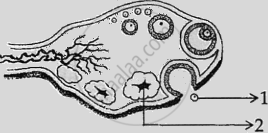
- Name the process for the release of the part labelled 1.
- Write the name of the structure marked 2.
What do mammary glands produce to nourish the offspring after birth?
