Advertisements
Advertisements
प्रश्न
Name the function of the following:
Fimbriae
Advertisements
उत्तर
They are finger-like projections at the ovarian end of the fallopian tube. They help in the collection of the ovum (after ovulation), which is facilitated by the beating of the cilia.
APPEARS IN
संबंधित प्रश्न
State the function of Ovary.
Given here is a section of the female reproductive system of human beings.
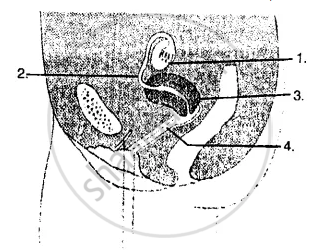
Name the parts labelled 1 to 4
Differentiate between:
Prostate gland and cowper’s gland (the nature of secretion)
Complete the paragraph with the help of words given in the bracket.
(Luteinizing hormone, endometrium of uterus, follicle stimulating hormone, estrogen, progesterone, corpus luteum)
Growth of follicles present in the ovary occurs under the effect of ______. This follicle secretes estrogen. ______ grows/regenerates under the effect of estrogen. Under the effect of ______, fully grown up follicle bursts, ovulation occurs and ______ is formed from remaining part of follicle. It secrets ______ and ______. Under the effect of these hormones, glands of ______ are activated and it becomes ready for implantation.
Modern techniques like surrogate mother, sperm bank and IVF technique will help the human beings. Justify this statement.
After puberty human female shows cyclic changes in her reproductive system. Explain structural and hormonal changes in the uterus.
(OR)
Give reasons :
(1) Scrotal sac serves as thermoregulator.
(2) Corpus luteum gets converted into corpus albicans in absence of fertilization.
(3) Missing of menses is the first indication of pregnancy.
(4) Surgical sterilization is a permanent method of birth control. (5) Human egg is microlecithal.
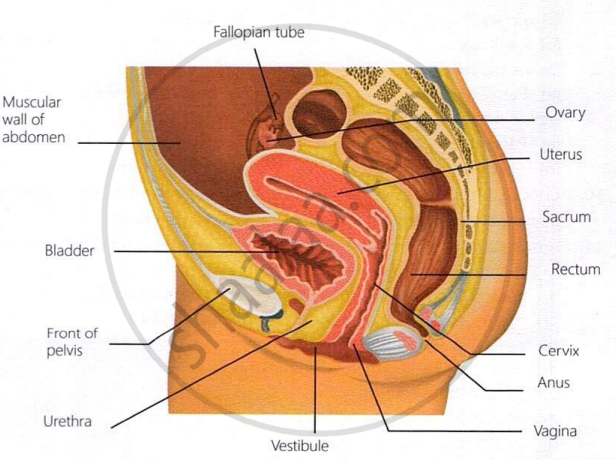
The diagram alongside is the vertical section of female reproductive organs. Study the diagram and answer the questions that follow:
- Name the fully developed part of ovary containing the ovum.
- Name the organ of the female body in which the foetus develops.
- What is ovulation?
- Which two hormones are secreted by ovary?
Write the functional activity of the following structure:
Inguinal canal
The stalk of the ovule is called a pedicle.
Womb is used to refer ______.
______ is homologous to Bartholin's glands.
Where does the ovum receive the sperm?
The estrus cycle is a characteristic of ______.
Which one is correct for mammalian testis?
The external genitalia of the human female is called ______.
When the foetus is growing inside the uterus it needs nutrients. Which part provides these nutrients?
State whether the following statement is True or False. If false, correct the statement:
In adult human females, a single mature egg is released into an oviduct every month.
Anterior lobe of pituitary secretes:
The oviducts are also known as ______.
One mature ovum is released once every ______ days.
What is parturition?
What are the functions of the ovaries and uterus in the female reproductive system?
The ______ is also called the womb.
The ______ is also called the womb.
The ______ is also called the womb.
Name these:
2 hormones secreted from the corpus luteum.
The ______ is also called the womb.
How many ovaries are present in the female reproductive system?
Which part of the fallopian tube has a narrow lumen and connects the tube to the uterus?
