Advertisements
Advertisements
प्रश्न
The below diagram represents the vertical view of the human female reproductive system.
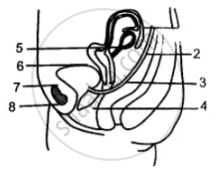
(i) Label the parts indicated by the guidelines 1 to 8.
(ii) How does the uterus prepare for the reception of a zygote?
(iii) What happens to the uterus if fertilization takes place?
(iv) What happens to the uterus if fertilization has failed to take place?
Advertisements
उत्तर
(i)
1. Oviduct
2. Funnel of oviduct
3. Ureter
4. Vagina
5. Ovary
6. Uterus
7. Bladder
8. Urethra
(ii) The endometrium lining and glands of the uterine wall grow to prepare the uterus for the reception of a zygote.
(iii) If fertilization takes place, the embryo is implanted in the uterus. The uterus wall develops a placenta which attaches the embryo to the uterus and the uterine wall expands to accommodate the growing embryo.
(iv) If fertilization fails to take place, menstruation takes place during which endometrium of the uterus is cast off. The capillaries and cells of this layer rupture and disappear.
APPEARS IN
संबंधित प्रश्न
Name the Following
The age or period when the reproductive organs become fully operational.
Name the part of the human female reproductive system where the following occurs.
Implantation
Stratum germinativum is an example of which kind of epithelium?
What is placenta? Mention its role during pregnancy?
In human beings, the correct sequence of events during reproduction is
Mother gives birth to a baby but the baby has characters of both parents. How is this possible?
The______ is also called the womb.
The ______ is also called the womb.
Which statement correctly describes the basic composition of each breast?
Which sequence correctly traces the milk pathway from alveoli to nipple?
