Advertisements
Advertisements
प्रश्न
The below diagram represents the vertical view of the human female reproductive system.
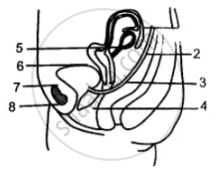
(i) Label the parts indicated by the guidelines 1 to 8.
(ii) How does the uterus prepare for the reception of a zygote?
(iii) What happens to the uterus if fertilization takes place?
(iv) What happens to the uterus if fertilization has failed to take place?
Advertisements
उत्तर
(i)
1. Oviduct
2. Funnel of oviduct
3. Ureter
4. Vagina
5. Ovary
6. Uterus
7. Bladder
8. Urethra
(ii) The endometrium lining and glands of the uterine wall grow to prepare the uterus for the reception of a zygote.
(iii) If fertilization takes place, the embryo is implanted in the uterus. The uterus wall develops a placenta which attaches the embryo to the uterus and the uterine wall expands to accommodate the growing embryo.
(iv) If fertilization fails to take place, menstruation takes place during which endometrium of the uterus is cast off. The capillaries and cells of this layer rupture and disappear.
APPEARS IN
संबंधित प्रश्न
Complete the following statement by choosing the correct alternative:
Menstrual flow is a character is the feature of ______.
Why is zona pellucid retained around the egg till it reaches the uterus?
Draw a label diagram.
Draw a sectional view of the human ovary showing the different stages of developing follicles, corpus luteum, and ovulation.
The largest cell in the human body of a female is ______.
The development of lactiferous tubules during pregnancy is dependent on ____________.
______ is not a part of the female reproductive system in human beings.
The diagram given below shows a section of the human ovary.
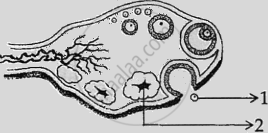
- Name the process for the release of the part labelled 1.
- Write the name of the structure marked 2.
Median vertical depression of external genitalia in females, enclosing the urethral and vaginal opening is ______.
Which ovarian hormone is associated with secondary sexual characteristics?
Where does the zygote implant?
