Advertisements
Online Mock Tests
Chapters
2: Fundamentals of Genetics
3: Absorption by Roots
4: Transpiration
5: Photosynthesis
6: The Circulatory System
7: The Excretory System
8: The Nervous System and Sense Organs
9: The Endocrine System
▶ 10: The Reproductive System
11: Human Population
12: Physical Health and Hygiene
13: Pollution
![ICSE solutions for बायोलॉजी [अंग्रेजी] कक्षा १० आईसीएसई chapter 10 - The Reproductive System - Shaalaa.com](/images/biology-english-class-10-icse_6:5f2b1b2038084cf381bfa42c826a928c.jpg "ICSE solutions for बायोलॉजी [अंग्रेजी] कक्षा १० आईसीएसई chapter 10 - The Reproductive System")
Advertisements
Solutions for Chapter 10: The Reproductive System
Below listed, you can find solutions for Chapter 10 of CISCE ICSE for बायोलॉजी [अंग्रेजी] कक्षा १० आईसीएसई.
ICSE solutions for बायोलॉजी [अंग्रेजी] कक्षा १० आईसीएसई 10 The Reproductive System Short Questions
What is sexual reproduction? What are its essential features?
Give two important unique features of the human reproductive system.
Name the various organs of the male reproductive system of man.
What are the functions of testes?
Write in sequence the regions in which a mature sperm travels from the seminiferous tubules up to the urethral opening?
What is semen?
What is fertilization? Name the site of fertilization in the human females.
What are the signs of puberty in human males and females?
What differences are there in number, structure, and activity of the male and female gametes in a man?
Rewrite the following terms in a correct and logical sequence:
The luteal phase, follicular phase, menstrual phase, ovulatory phase.
Differentiate on the basis of what is indicated in brackets :
The prostate gland and Cowper’s gland (the nature of secretion)
Define the four stages in the uterine cycle.
Where does fertilization occur?
Name two essential structures which take part in fertilization.
Name two essential structures which take part in fertilization.
Name the female sex hormones and structures which secrete them.
How is the fetus protected?
What is Placenta?
How is Placenta formed? What are its functions?
Mention three functions of the placenta.
The circulatory system of the fetus and that of the mother are never connected directly. What are the advantages?
What changes occur at the time of birth?
Describe briefly the ways how a mammalian embryo is protected
Describe briefly the ways how a mammalian embryo is nourished
Describe briefly the ways how a mammalian embryo is respires
What do you understand by an inguinal hernia?
What do you mean by identical and fraternal twins?
ICSE solutions for बायोलॉजी [अंग्रेजी] कक्षा १० आईसीएसई 10 The Reproductive System Give Reasons
Give Reasons
Gametes have a haploid (n) number of chromosomes.
Give Reasons
The urethra is also called urinogenital duct.
Give Reasons
At the time of birth, the testes descend into the scrotal sacs.
Give Reasons
Missing of menses is the first indication of pregnancy.
Give Reasons
The chances of pregnancy to occur are most favourable on or about the 14th day of the menstrual cycle. Explain.
Give Reasons
Millions of sperms are produced at ejaculation yet one sperm actually fertilizes the ovum. Explain.
Give Reasons
A large number of sperms are required for fertilizing one egg.
Give Reasons
The acrosome of sperm secretes an enzyme called hyaluronidase at the time of fertilization
Give Reasons
The oviduct funnel is lined with cilia.
Give Reasons
Most often only one embryo is formed at a time although there are two ovaries in women. Explain.
Give Reasons
The full-grown human embryo respires but does not breathe.
ICSE solutions for बायोलॉजी [अंग्रेजी] कक्षा १० आईसीएसई 10 The Reproductive System Differentiate
Differentiate
External fertilization and Internal fertilization.
Differentiate
Amnion and Chorion.
Differentiate
Uterus and Urethra.
Differentiate
Urinogenital system and Urinary system.
Differentiate
Fetus and Embryo.
Differentiate
Isogametes and Heterogametes.
Differentiate
Urinogenital duct and Ureter.
Differentiate between tubectomy and vasectomy.
Differentiate between the Tubectomy and Vasectomy (Part cut and tied)
Differentiate
Sexual Reproduction and Asexual Reproduction.
Differentiate between the graafian follicle and corpus luteum.
ICSE solutions for बायोलॉजी [अंग्रेजी] कक्षा १० आईसीएसई 10 The Reproductive System Diagram Based Questions
Given below is a diagram of the lateral section of the testis of a man. Study the same and answer the questions that follow:

(i) Label the parts numbered 1 to 4 of the diagram.
(ii) State the functions of the parts labeled 1 and 3.
(iii)What is the significance of the testes being located in the scrotal sac outside the abdomen?
(vi)What is the role played by the inguinal canal?
(v) What is semen?
The diagram shown below is the lateral section of the testis of man. Study it carefully and answer the questions that follow:

(i) Label the part I to 4 of the diagram.
(ii) State the functions of the parts labeled 1 and 2.
The below diagram represents the sectional view of the female reproductive organs of a mammal.

(i) Label the parts numbered 1 to 7.
(ii) What are the main functions of the parts labeled 2, 5, 6?
Given below is a diagram of the female reproductive system of a human being

(i) Name the parts numbered 1 to 6.
(ii) Normally after how many days does an ovary release an egg?
(iii) Where are the sperms released during coitus?
(iv) What do the sperms do after being released?
(v) What is the function of the organ numbered 5?
(vi) How many days does it normally take from the fertilization of the egg up to the birth of the baby?
The below diagram represents the vertical view of the human female reproductive system.
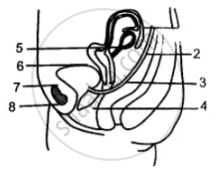
(i) Label the parts indicated by the guidelines 1 to 8.
(ii) How does the uterus prepare for the reception of a zygote?
(iii) What happens to the uterus if fertilization takes place?
(iv) What happens to the uterus if fertilization has failed to take place?
Given below is the outline of the male reproductive system.
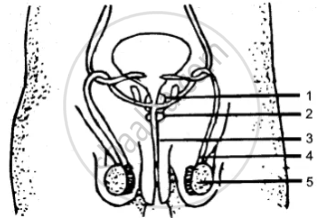
(i) Name the parts labeled 1 to 5.
(ii) State the functions of the parts labeled 1 and 4.
(iii) Name the cells of part 5 that produce testosterone.
(iv) Why is structure 5 present outside the body in the scrotal sacs?
(v) What is semen?
Study the diagram given below and then answer the questions that follow:
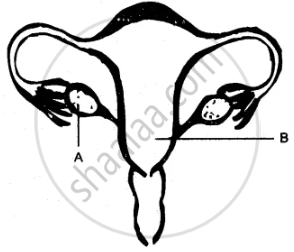
(i) Name the part labeled A. Name any two hormones produced by the part labeled A.
(ii) What happens to the part labeled B.
(1) if fertilization takes place?
(2) If fertilization does not take place?
(iii) Where does fertilization occur?
(iv) Draw a neat diagram of the human sperm as seen under high magnification and label the following parts.
(1) Acrosome
(2) Mitochondria
The diagram given below is that of a developing human foetus in the womb. Study the same and then answer the questions that follow:
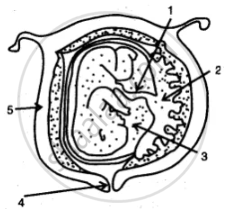
- Name the parts '1' to '5' indicated by guidelines.
- What term is given to the period of development of the foetus in the womb?
- How many days does the foetus take to be fully developed?
- Mention two functions of the parts labelled ‘2’ other than its endocrine function.
- Name the hormone (anyone) produced by the part labelled ‘2’.
- What is the function of the part marked ‘3’?
The adjoining figure represents the female reproductive organ of the humans
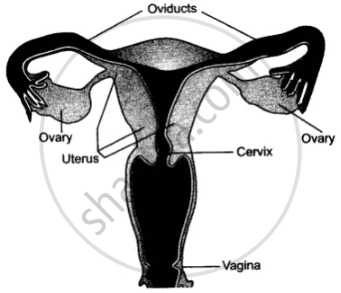
(i) How does the human embryo developing in the uterus obtain its nourishment?
(ii) Which structure protects and nourishes the developing embryo?
(iii) Define ovulation.
The diagram below represents two reproductive cells A and B. Study the same and then answer the questions that follow:
 |
- Identify the reproductive cells A and B.
- Name the specific part of the reproductive system where the above cells are produced.
- Where in the female reproductive system do these cells unite?
- Name the main hormones secreted by the (1) ovary (2) testes.
- Name an accessory gland found in the male reproductive system and state the function of its secretion.
The diagram given below shows an embryo in the uterus of mammal. Label the parts indicated.

Study the diagram given below and then answer the questions that follow:
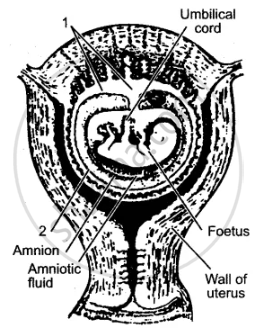
(i) Name the parts labeled 1 and 2. State the function of each part.
(ii) State any one function of the amniotic fluid.
(iii) What is the role of the umbilical cord in the development of the fetus?
(iv) Name the part in the diagram which is endocrine in nature.
The below diagram is of a developing embryo is a mother’s womb:
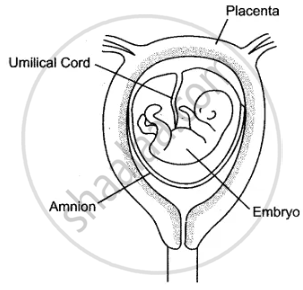
(i) Write the functions of the placenta, amnion, and umbilical cord.
(ii) How are the waste products of a fetus removed?
(iii) What is the gestation period?
ICSE solutions for बायोलॉजी [अंग्रेजी] कक्षा १० आईसीएसई 10 The Reproductive System Sketch and Label the Diagram
Draw a labeled diagram of sperm.
Sketch and label Human Male Reproductive System.
Draw a labeled diagram of the human female reproductive system.
Give a labeled structure of ovum.
ICSE solutions for बायोलॉजी [अंग्रेजी] कक्षा १० आईसीएसई 10 The Reproductive System Explain the Terms
Explain the Term Vas deferens.
Explain the Term Penis.
Explain the term Graffian follicle.
Explain the term Gametogenesis.
Explain the term Androgens.
Explain the term Cowper’s glands.
Explain the term Scrotum.
Explain the term Parturition or birth.
Explain the term Fetus
Explain the term Secondary sexual characters.
Explain the term Tubectomy.
Explain the term Vasectomy.
ICSE solutions for बायोलॉजी [अंग्रेजी] कक्षा १० आईसीएसई 10 The Reproductive System Name the Following
Name the Following
The age or period when the reproductive organs become fully operational.
Name the Following
The term used when beard and mustache appear, harshening of voice, broadening of shoulders, etc. takes place.
Name the Following
The basic unit of the testes.
Name the Following
Male copulatory organ.
Name the Following
The male gamete (male reproductive cells) of mammals.
Name the Following
The tubular knot fitting like a cap on the upper surface of the testes.
Name the Following
The site of production of sperms in man.
Name the Following
The structure in which testes are present in man.
Name the Following
The accessory gland in human males whose secretion activates the sperms.
Name the Following
Muscular extension of cauda epididymis.
Name the Following
The hormone that stimulates the development of secondary sexual characters in males.
Name the Following
A female gonad is responsible for the production of ova.
Name the Following
The female copulatory organ in humans.
Name the Following
The structure formed after the release of ovum from the Graffian follicle.
Name the Following
The term used for the mature follicles.
Name the Following
A cellular sac containing maturing egg.
Name the Following
The onset of menstruation in a young girl at about the age of 13 years.
Name the Following
Sloughing of the uterine wall during menstrual flow.
Name the Following
The term used when females stop menstruation at the age of 45-50 years.
Name the Following
A hollow pear-shaped muscular organ that holds, nourishes and protects the fetus.
Name the Following:
The process of attachment of fertilized ovum to the uterine wall.
Name the Following
How the embryo inside the uterus is protected from jerks or mechanical shocks.
Name the Following
The hormone that stimulates the contraction of the uterus during childbirth.
Name the Following
The expulsion of the fetus from the body of the mother.
Name the Following
Days in the human gestation period.
Name the Following
Surgical operation of the fallopian tubes in females for family planning.
Name the Following
What does this abbreviation stand for LH?
Name the Following
What does this abbreviation stand for FSH?
Name the Following
What does this abbreviation stand for IUD?
ICSE solutions for बायोलॉजी [अंग्रेजी] कक्षा १० आईसीएसई 10 The Reproductive System Give Technical Terms
Give the appropriate term for the following:
Process of fusion of ovum and sperm.
Give Technical Term:
Name the male gamete of a mammal.
Give Technical Term:
How much semen is discharged per ejaculation in a man?
Give Technical Term:
In which organ of the male reproductive system maturation of sperms takes place?
Give Technical Term:
Name the male reproductive cells of mammals.
Give Technical Term:
What term is used for the production and maturation of sperms in the testes?
Name the following:
The canal through which the testes descend into the scrotum just before birth in human male child.
Give Technical Term:
The place where fertilization occurs in the female reproductive system.
Give Technical Term:
Name the tube that leads from the ovary to the uterus.
Give Technical Term:
What term is used for the production and maturation of eggs in the ovaries?
Give Technical Term:
Name the connective tissue surrounding the ovary.
Give the appropriate term for the following:
Monthly discharge of blood and disintegrated tissues in the human female
Give appropriate term of the following:
The onset of reproductive phase in a young female.
Give Technical Term:
Rupture of the follicle and release of the ovum from the ovary.
Give Technical Term:
Which part develops during the advanced pregnancy?
Give Technical Term:
What term is used for the arrest of reproductive capacity in females?
Give Technical Term:
What are the age restrictions for marriages by law for boys and girls in India?
Give Technical Term:
In how many weeks fetus development is completed?
Give Technical Term:
The part in the uterus which is concerned with the supply of nutrition from the mother to the fetus.
Give Technical Term:
Name a membrane that surrounds the fetus and secretes a protective fluid.
Name the following:
The fluid surrounding the developing embryo
Give Technical Term:
The period of intrauterine development of the embryo.
Give Technical Term:
A structure which connects the placenta with the fetus.
Give Technical Term:
A method of contraception in which the sperm duct is cut and ligated.
Give Technical Term:
The phase in the menstrual cycle in which the remnant of a follicle in the ovary turns to corpus luteum.
ICSE solutions for बायोलॉजी [अंग्रेजी] कक्षा १० आईसीएसई 10 The Reproductive System Fill in the Blanks
Complete the following sentences with appropriate word:
The sperms in a human male are produced in _____.
Complete the following sentences with appropriate word:
___________ hormones are secreted by the interstitial cells.
Complete the following sentences with appropriate word:
The surgical sterilization of males is known as _________.
Complete the following sentences with appropriate word:
Fertilization of the human egg by the sperm normally occurs in the_______
Complete the following sentences with appropriate word:
The period of complete development of the fetus until birth is termed ______.
Complete the following sentences with appropriate word:
The umbilical cord connects _______
Complete the following sentences with appropriate word:
The process of releasing an egg from the ovary is called _________.
Complete the following sentences with appropriate word:
A hormone secreted in a female to facilitate parturition is ________.
Complete the following sentences with appropriate word:
The placenta is ________permeable
Complete the following sentences with appropriate word:
One egg is normally released from the ovary in the human females after
__________
Complete the following sentences with appropriate word:
The human gestation period is about ____________.
Complete the following sentences with appropriate word:
The expulsion of the fetus from the body to the mother in a human female is called __________.
Complete the following sentences with appropriate word:
The female equivalent of the penis is the _______.
Complete the following sentences with appropriate word:
The embryo inside the uterus is protected from jerks or mechanical shocks by ________
ICSE solutions for बायोलॉजी [अंग्रेजी] कक्षा १० आईसीएसई 10 The Reproductive System True & False
Mention, if the following statement is True or False. If false rewrite the wrong statement in its correct form:
Sperm is a single cell.
True
False
Mention, if the following statement is True or False. If false rewrite the wrong statement in its correct form:
Sperm is a highly motile male gamete.
True
False
Mention, if the following statement is True or False. If false rewrite the wrong statement in its correct form:
Vas deferens transports sperms into the urethra.
True
False
Mention, if the following statement is True or False. If false rewrite the wrong statement in its correct form:
Cowper’s gland opens into the urethra.
True
False
Mention, if the following statement is True or False. If false rewrite the wrong statement in its correct form:
The process of fusion of the sperm nucleus and the egg nucleus is termed implantation.
True
False
Mention, if the following statement is True or False. If false rewrite the wrong statement in its correct form:
A zygote is the product of the fusion of male and female gametes.
True
False
Mention, if the following statement is True or False. If false rewrite the wrong statement in its correct form:
Women after the age of 45 years normally cannot produce children.
True
False
Mention, if the following statement is True or False. If false rewrite the wrong statement in its correct form:
The cilia lining the oviduct funnel, push the released ovum into the uterus.
True
False
Mention, if the following statement is True or False. If false rewrite the wrong statement in its correct form:
Menarche is the stoppage of menstruation.
True
False
Mention, if the following statement is True or False. If false rewrite the wrong statement in its correct form:
Fertilization is the product of the egg nucleus and the sperm nucleus.
True
False
Rewrite the correct statement by changing the last one word if these statement is false.
Pregnancy in women can be prevented by the method of vasectomy.
True
False
Mention, if the following statement is True or False. If false rewrite the wrong statement in its correct form:
Tubectomy involves the cutting and tying of the vas deferens in males.
True
False
ICSE solutions for बायोलॉजी [अंग्रेजी] कक्षा १० आईसीएसई 10 The Reproductive System State the Location
State the Location:
Uterus
State the Location:
Seminal vesicle
State the location:
Prostate gland
State the Location:
Ovary
State the Location:
Cowper’s glands
State the Location:
Bartholin’s glands.
ICSE solutions for बायोलॉजी [अंग्रेजी] कक्षा १० आईसीएसई 10 The Reproductive System State the Function
Write the functional activity of the following structure:
Uterus
Write the functional activity of the following structure:
Amnion
Write the functional activity of the following structure:
Prostate gland
Write the functional activity of the following structure:
Seminiferous tubules
Write the functional activity of the following structure:
Fallopian tubes
Write the functional activity of the following structure:
Seminal vesicles
Write the functional activity of the following structure:
Ovary
Write the functional activity of the following structure:
Testis
Write the functional activity of the following structure:
Placenta
Write the functional activity of the following structure:
Cowper’s gland
Write the functional activity of the following structure:
Seminal fluid
Write the functional activity of the following structure:
Inguinal canal
Write the functional activity of the following structure:
Urethra
Write the functional activity of the following structure:
Graafian follicle
ICSE solutions for बायोलॉजी [अंग्रेजी] कक्षा १० आईसीएसई 10 The Reproductive System Choose the Odd One Out
Choose the Odd One Out:
Testes
Prostate gland
Seminal vesicle
Cowper’s gland
Choose the Odd One Out:
Vas deferens
Fallopian tube
Epididymis
Cowper’s gland
Choose the Odd One Out:
Testis
Penis
Oviduct
Seminiferous tubules
Choose the Odd One Out:
Oxytocin
Insulin
Prolactin
Progesterone
Choose the Odd One Out:
Oestrogen
Progesterone
Testosterone
Prolactin
Choose the Odd One Out:
Larynx
Pancreas
Testis
Ovary
Choose the Odd One Out:
Fallopian tube
Vagina
Uterus
Ovaries
Choose the Odd One Out:
Fallopian tube
Uterus
ovaries
Ureter
Choose the Odd One Out:
Graafian follicle
Corpus ostium
Corpus Albicans
Choose the Odd One Out:
Vagina
Vulva
Seminal vesicle
Uterus
Choose the Odd One Out:
Ovum
Corpus luteum
Scrotal sacs
Ovary
ICSE solutions for बायोलॉजी [अंग्रेजी] कक्षा १० आईसीएसई 10 The Reproductive System Multiple Choice Questions
Multiple Choice Question:
Which one of the following Is the route that a sperm follows when it leaves the testes of a mammal?
Vas deferens → epididymis → urethra
Urethra → epididymis → vas deferens
Epididyrnis → urethra → vas deferens
Epididymis → vas deferens → urethra
Multiple Choice Question:
If the vas deference of a man are surgically disconnected or removed.
Semen will be without sperm
Sperms in the semen will be without nude
Spermatogenesis will not take place
Sperms in semen will be non-motile
Multiple Choice Question:
What will happen if the temperature of the scrotal sacs temporarily goes to about 2°C lower than body temperature?
Sperm formation will be stopped
Testes will start rotation movement
Scrotal sacs will contract and come close to the body
Scrotal sacs will relax and go down away from the body
Multiple Choice Question:
Fertilization means:
The transfer of male gamete to the female gamete
The adhesion of male and female reproductive organs
The fusion of nuclei of male and female gametes
The shedding of gametes from a reproductive organ
The site of maturation of human sperms is the
Seminiferous tubule
Interstitial cells
Epididymis
Prostate gland
Multiple Choice Question:
The onset of menstruation in the female is termed
Ovulation
Menarche
Menopause
Parthenogenesis
Multiple Choice Question:
Ovulation in mammals is a process in which
The egg is released from Graffian follide
The egg is fertilized in the fallopian tube
The egg passes through a fimbriated funnel of the fallopian tube
The unfertilized egg passes out of a female’s body
Multiple Choice Question:
Sterilization in the female involves cuffing and tying the
Ureter
Uterus
Urethra
Oviduct
Multiple Choice Question:
Corpus luteum in mammals occurs in
Brain and connects the two cerebral hemispheres
Ovaries and produces progesterone hormone
Heart and initiates atrial contraction
Skin and acts as a pain receptor
ICSE solutions for बायोलॉजी [अंग्रेजी] कक्षा १० आईसीएसई 10 The Reproductive System Match the Column
Column ‘II’ is a list of items related to ideas in Column ‘I’. Match the term in Column ‘II’ with a suitable idea given in Column ‘I’.
| Column I | Column II |
| (i) Acrosome
(ii) Ovulation (iii) Sperm (iv) Menopause (v) Implantation (vi) Fertilization (vii) Contraception in males |
(a) Male gamete
(b) Oviduct (c) Uterus (d) Spermatozoa (e) Progesterone (f) Stoppage of the menstrual cycle (g) Sudden change in genes |
Solutions for 10: The Reproductive System
ICSE solutions for बायोलॉजी [अंग्रेजी] कक्षा १० आईसीएसई chapter 10 - The Reproductive System
Shaalaa.com has the CISCE Mathematics बायोलॉजी [अंग्रेजी] कक्षा १० आईसीएसई CISCE solutions in a manner that help students grasp basic concepts better and faster. The detailed, step-by-step solutions will help you understand the concepts better and clarify any confusion. ICSE solutions for Mathematics बायोलॉजी [अंग्रेजी] कक्षा १० आईसीएसई CISCE 10 (The Reproductive System) include all questions with answers and detailed explanations. This will clear students' doubts about questions and improve their application skills while preparing for board exams.
Further, we at Shaalaa.com provide such solutions so students can prepare for written exams. ICSE textbook solutions can be a core help for self-study and provide excellent self-help guidance for students.
Concepts covered in बायोलॉजी [अंग्रेजी] कक्षा १० आईसीएसई chapter 10 The Reproductive System are Reproduction, The Female Reproductive System, Menstrual Cycle (Ovarian Cycle), Role of Hormones in Reproduction, Parturition (Birth) in Human, Human Reproduction, The Male Reproductive System, Placenta (Growth) in Human, Twins - Fraternal & Identical, Multiple Births: Triplets, Quadruplets, etc..
Using ICSE बायोलॉजी [अंग्रेजी] कक्षा १० आईसीएसई solutions The Reproductive System exercise by students is an easy way to prepare for the exams, as they involve solutions arranged chapter-wise and also page-wise. The questions involved in ICSE Solutions are essential questions that can be asked in the final exam. Maximum CISCE बायोलॉजी [अंग्रेजी] कक्षा १० आईसीएसई students prefer ICSE Textbook Solutions to score more in exams.
Get the free view of Chapter 10, The Reproductive System बायोलॉजी [अंग्रेजी] कक्षा १० आईसीएसई additional questions for Mathematics बायोलॉजी [अंग्रेजी] कक्षा १० आईसीएसई CISCE, and you can use Shaalaa.com to keep it handy for your exam preparation.
