Advertisements
Advertisements
प्रश्न
Choose the Odd One Out:
विकल्प
Vas deferens
Fallopian tube
Epididymis
Cowper’s gland
Advertisements
उत्तर
Fallopian tube
संबंधित प्रश्न
What could be the reasons for adopting contraceptive methods?
Give biological explanations for All the food chains begin with green plants.
Mention two functions of human testes.
Where does fertilisation take place in human females?
In a flower, the parts that produce male and female gametes are respectively :
(a) sepal and anther
(b) filament and stigma
(c) anther and ovary
(d) stamen and style
“Gender of child is determined by the male partner of couple”. Draw a diagram explaining the above statement.
The below diagram is of a developing embryo is a mother’s womb:
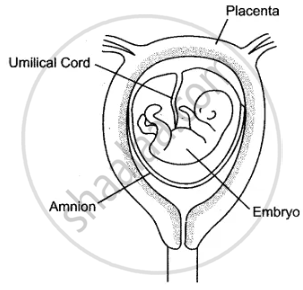
(i) Write the functions of the placenta, amnion, and umbilical cord.
(ii) How are the waste products of a fetus removed?
(iii) What is the gestation period?
Choose the Odd One Out:
Match Columns I and II and select the correct option.
| Columns I | Columns II | ||
| i. | Transfer of sperms in the female genital tract. | a. | Gestation |
| ii. | Delivery of baby | b. | Fertilization |
| iii. | Fusion of male and female gamete. | c. | Parturition |
| iv. | Formation of sperms and ovum | d. | Insemination |
| e. | Gametogenesis |
