Advertisements
Advertisements
प्रश्न
Give scientific reasons: When an ovum gets fertilized, menstrual cycle stops temporarily in a woman.
Advertisements
उत्तर
In case of fertilisation of the ovum by a sperm, the corpus luteum persists and continues to secrete progesterone in the body thus maintaining its high levels. The presence of progesterone prevents the maturation of another ovum, thus temporally stopping the menstrual cycle.
APPEARS IN
संबंधित प्रश्न
Suggest three contraceptive methods to control the size of human population, which is essential for the health and prosperity of a country. State the basic principle involved in each.
What are sexually transmitted diseases?
Give biological explanations for All the food chains begin with green plants.
Where is the female gamete formed in humans?
One of the following is not a part of the human male reproductive system. This is:
When a female child is born, her ovaries already contain thousands of immature eggs (or ova) contained in immature structures A. On maturing, A bursts open and an egg shoots out of the ovary in a process called B. The process B starts in the females at puberty and occurs again and again after a time period x. Before every occurrence of process B, the inner lining of uterus becomes thick and soft with lots of blood vessels in it. When the egg cell gets fertilised by a sperm, then an event C occurs in the life of mature human female which lasts for time period y leading to the birth of baby. If, however, the egg cell released by the ovary does not get a sperm to fuse with, then the thick and soft inner lining of uterus breaks down and comes out of the female's body in an event called D. The occurrence of event D is controlled by chemical substances E.
(a) What are A?
(b) What is process B?
(c) What is the time period x?
(d) Name the event C.
(e) How much is the time period y?
(f) What is the name of process D?
(g) Name the chemical substances E.
Write two examples of sexually transmitted diseases caused by virus.
Give the names:
Any two sexual diseases.
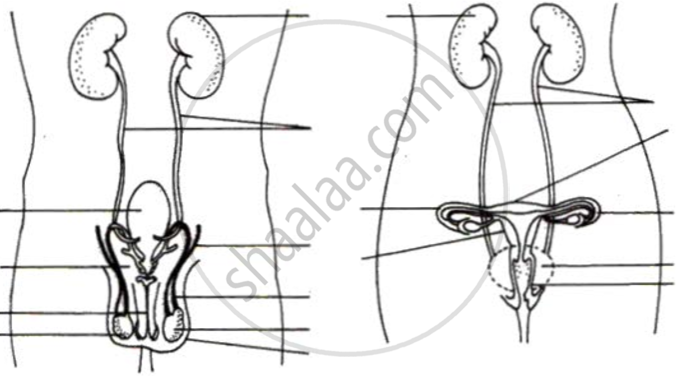
Label the folowing diagram
Mention the importance of the position of the testes in humans.
