Advertisements
Advertisements
प्रश्न
Give scientific reasons: Mature erythrocytes in humans lack nucleus and mitochondria
Advertisements
उत्तर
In case of fertilisation of the ovum by a sperm, the corpus luteum persists and continues to secrete progesterone in the body thus maintaining its high levels. The presence of progesterone prevents the maturation of another ovum, thus temporally stopping the menstrual cycle.
APPEARS IN
संबंधित प्रश्न
A single highly coiled tube where sperms are stored gets concentrated, and mature is known as ______
Name the liquid that contains sperms.
fertilisation in humans can occur only once in a month. Why?
When a human female reaches a certain age then vaginal bleeding occurs for a few days after regular time intervals.
(a) What is this process known as (i) in scientific terms, and (ii) in everyday language?
(b) At what approximate age this process starts in human females? When is the human female said to have attained at this stage?
(c) After how much time is this process repeated? For how many days does this process usually last?
(d) What does the onset of this process in human females signify?
(e) At which particular event in the life of a human female does this process stop temporarily but start again?
(f) At which approximate age of human female does this process stop permanently?
X and Y are two human beings. The organ A in the reproductive system of X releases a mature gamete B once a month which goes into a tube-like structure C through a funnel-like opening. The organ D in the reproductive system of Y makes and releases gametes E which pass through a duct F and are introduced by an organ of Y, into the body of X. B and E fuse together in C to form a new cell G. The cell G divides repeatedly to form a ball of cells H which gets embedded in the lining of organ I of reproductive system of X where it grows and develops into a baby.
(a) Name (i) organ A, and (ii) gamete B.
(b) Write two names of tube-like structure C.
(c) Name (i) organ D, and (ii) gamete E.
(d) Write two names of duct F.
(e) Name (i) cell G (ii) ball of cells H, and (iii) organ I.
(f) Out of X and Y, which one is (i) male, and (ii) female?
The diagram below represents two reproductive cells A and B. Study the same and then answer the questions that follow:
 |
- Identify the reproductive cells A and B.
- Name the specific part of the reproductive system where the above cells are produced.
- Where in the female reproductive system do these cells unite?
- Name the main hormones secreted by the (1) ovary (2) testes.
- Name an accessory gland found in the male reproductive system and state the function of its secretion.
Give the names:
Any two sexual diseases.
Identify the given diagram.
Name the parts 1 to 5. 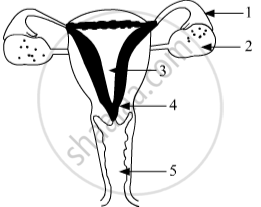
Choose the Odd One Out:
Consider the following:
- The reductive division for the human female gametogenesis starts earlier than that of the male gametogenesis.
- The gap between the first meiotic division and the second meiotic division is much shorter for males compared to females.
- The first polar body is associated with the formation of the primary oocyte.
- Luteinising Hormone (LH) surge leads to disintegration of the endometrium and onset of menstrual bleeding.
Choose the correct answer from the options given below:
