Advertisements
Advertisements
Question
Female reproductive organs and associated functions are given below in column A and B. Fill the blank boxes.
| Column A | Column B |
| Ovaries | Ovulation |
| Oviduct | a |
| b | Pregnancy |
| Vagina | Birth |
Advertisements
Solution
| Column A | Column B |
| Ovaries | Ovulation |
| Oviduct | Fertilisation |
| Uterus | Pregnancy |
| Vagina | Birth |
APPEARS IN
RELATED QUESTIONS
Describe the human female reproductive system with a labelled diagram.
Fill in the blank:
Development of baby (foetus) takes place inside __________.
Mention the exact location of the following :
Amniotic fluid
Mention the exact location of the following :
Corpus callosum
Choose the correct answer:
Ovum is a ______________
Draw a label diagram.
Draw a sectional view of the human ovary showing the different stages of developing follicles, corpus luteum, and ovulation.
The adjoining figure represents the female reproductive organ of the humans
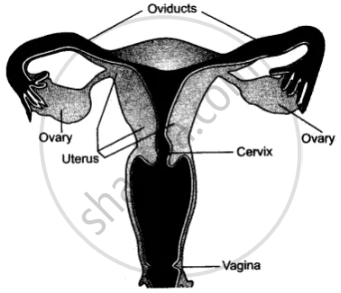
(i) How does the human embryo developing in the uterus obtain its nourishment?
(ii) Which structure protects and nourishes the developing embryo?
(iii) Define ovulation.
Write the functional activity of the following structure:
Inguinal canal
Write the functional activity of the following structure:
Graafian follicle
A neat labelled diagram describes the parts of a typical angiospermic ovule.
All are associated with ovulation in human female, EXCEPT
Which of the following statements regarding human reproduction is INCORRECT?
Breasts are the modified ______ glands.
Cleavage in mammalian egg is ______.
In oocyte secondary maturation occurs in ______.
The finger-like projections, called fimbriae, help in the collection of ovum into the fallopian tube following ovulation.
Tubectomy is carried out by blocking the ______
Given below is a certain situation. Analyze and describe its possible impact on a person:
Placenta does not attach to the uterus optimally.
Choose the odd one out from the group of terms given below and write the category for the remaining terms:
Where do alveoli store milk?
