Advertisements
Advertisements
प्रश्न
Female reproductive organs and associated functions are given below in column A and B. Fill the blank boxes.
| Column A | Column B |
| Ovaries | Ovulation |
| Oviduct | a |
| b | Pregnancy |
| Vagina | Birth |
Advertisements
उत्तर
| Column A | Column B |
| Ovaries | Ovulation |
| Oviduct | Fertilisation |
| Uterus | Pregnancy |
| Vagina | Birth |
APPEARS IN
संबंधित प्रश्न
Draw a diagrammatic sectional view of the female reproductive system of human and label the parts
(i) where the secondary oocytes develop
(ii) which helps in collection of ovum after ovulation
(iii) where fertilization occurs
(iv) where implantation of embryo occurs.
The diagram alongside is the vertical section of female reproductive organs. Study the diagram and answer the questions that follow:
- Name the fully developed part of ovary containing the ovum.
- Name the organ of the female body in which the foetus develops.
- What is ovulation?
- Which two hormones are secreted by ovary?
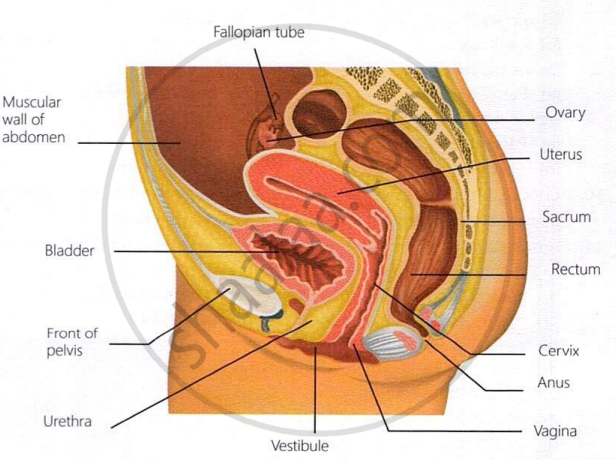
Name the following:
The part of the female reproductive system in which fertilization occurs.
Name the Following
The term used for the mature follicles.
Estrogen is secreted by ______
______ pollen mother cells should undergo meiotic division to produce 64 pollen grains.
Primordial follicle cells undergo mitotic division to produce ______.
All are internal genitalia in females. EXCEPT ______.
How many lobes are generally present in each mammary gland?
Which stage is followed after the secondary follicle stage?
Ovulation occurs under the influence of ______.
When both ovaries are removed from rat which hormone is decreased in blood?
The second maturation division of the mammalian ovum occurs ______.
In human females, an event that reflects onset of reproductive phase is
How can we say that fish exhibits external fertilisation?
______ acts as a birth canal.
Explain how the uterus and placenta provide necessary conditions for proper growth and development of the embryo after implantation?
Statement I: The presence or absence of hymen is not a reliable indicator of virginity.
Statement II: The hymen is torn during the first coitus only.
In the light of the above statements, choose the correct answer from the options given below:
Which uterine layer contracts strongly during childbirth delivery?
Which structure is a thin membrane partially covering the vaginal opening and has variable presence?
