Advertisements
Advertisements
Question
Differentiate between the graafian follicle and corpus luteum.
Advertisements
Solution
| Sr. No. | Feature | Graafian Follicle | Corpus Luteum |
| 1. | Definition | It is the final, mature stage of a developing ovarian follicle that contains a secondary oocyte. | It is a temporary endocrine structure formed from the remains of the graafian follicle after ovulation. |
| 2. | Timing | It is present in the ovary before ovulation occurs during the follicular phase of the menstrual cycle. | It is formed after ovulation occurs during the luteal phase of the menstrual cycle. |
| 3. | Hormonal Secretion | It primarily secretes the hormone estrogen, which helps thicken the uterine lining. | It primarily secretes progesterone, which is essential for maintaining the pregnancy. |
| 4. | Physical Appearance | It appears as a large, fluid-filled sac containing a cavity called the antrum. | It appears as a yellowish mass of cells (due to the pigment lutein) and is a solid structure. |
| 5. | Biological Fate | Its fate is to rupture to release the egg (ovum) into the fallopian tube. | If fertilization does not occur, it degenerates into a white fibrous tissue called corpus albicans. |
RELATED QUESTIONS
Choose the correct answer:
Ovum is a ______________
Name the following:
The organ of female in which the foetus develops.
Complete the following sentences with appropriate word:
The female equivalent of the penis is the _______.
The _______ is also called the womb.
Complete the table.
| Sex/Gender | Reasons of infertility |
| Female | |
| Male |
Match the parts of the given figure with the correct option.
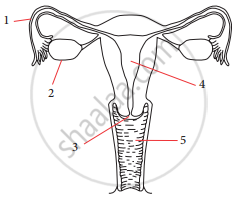
| 1 | 2 | 3 | 4 | 5 | |
| a. | Fallopian tube | Oviduct | Uterus | Cervix | Vagina |
| b. | Oviduct | Cervix | Vagina | Ovary | Vas deferens |
| c. | Ovary | Oviduct | Uterus | Vagina | Cervix |
| d. | Fallopian tube | Ovary | Cervix | Uterus | Vagina |
Development of mammary glands is controlled by ____________.
All are internal genitalia in females. EXCEPT ______.
Identify the layer of the uterine wall that undergoes changes during menstrual cycle.
During which process is the egg released from the Graafian follicle?
Which one the following is a part of external genitalia of a female human being?
Which of the following is correct about mammalian testes?
The finger-like projections, called fimbriae, help in the collection of ovum into the fallopian tube following ovulation.
Figure A shows the front view of the human female reproductive system and Figure B shows the development of a fertilized human egg cell
Figure A
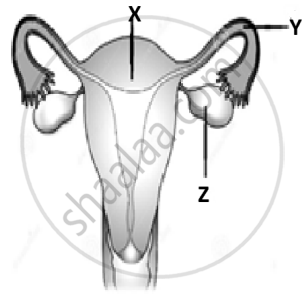
Figure B

Identify the correct stage of development of the human embryo (Figure B) that takes place at the sites X, Y, and Z respectively in the human female reproductive system (Figure A).
Choose the correct option from the table below:
| X | Y | Z | |
| A | Morula | Fertilized egg | Blastocyst |
| B | Unfertilized egg | Fertilized egg | Morula |
| C | Blastocyst | Fertilized egg | Unfertilized egg |
| D | Fertilized egg | Morula | Blastocyst |
What marks the beginning of the reproductive life of a woman?
Where does fertilization take place?
What changes are observed in the uterus if fertilisation does not occur?
With a suitable diagram, describe the organisation of mammary gland.
Which part of the fallopian tube is the wider, curved middle section and the site of fertilisation?
