Advertisements
Advertisements
Question
Given below is a diagram of the lateral section of the testis of a man. Study the same and answer the questions that follow:

(i) Label the parts numbered 1 to 4 of the diagram.
(ii) State the functions of the parts labeled 1 and 3.
(iii)What is the significance of the testes being located in the scrotal sac outside the abdomen?
(vi)What is the role played by the inguinal canal?
(v) What is semen?
Advertisements
Solution
(i)
1. Seminiferous tubules
2. Testicular lobule
3. Epididymis
4. Vas deferens
(ii)
1. Seminiferous tubules: sperm production, nourishment, and protection of sperm.
3. Epididymis: stores sperm, contributes to seminal fluid.
(iii) The scrotal sac acts as a thermoregulator. The temperature in the scrotal sac remains 2-3°C lower than the body temperature which is suitable for the maturation of sperm.
(iv) Through the inguinal canal, the sperm duct is connected and so passes the sperm to the urinary bladder.
(v) Semen is a mixture of mature sperm and secretions of’ various accessory glands. It is a milky fluid.
RELATED QUESTIONS
Differentiate between the following pair:
Hymen and clitoris
Differentiate between vas deferens and vasa efferentia.
In humans, sperm production occurs in the organ ______.
In the given diagram represents the
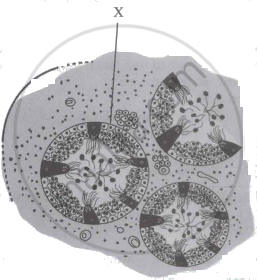
The spermatozoa from seminiferous tubules pass into ______.
In the male reproductive system, the vasa efferentia opens into the ______.
Semen is secreted by ______.
Which one of the following is not a male accessory gland?
Given below is the outline of the male reproductive system. Name the parts labelled 1 to 8. Also name the corresponding structure of part (4) in female reproductive system.
 |
What are spermatogonia?
