Topics
Reproduction in Lower and Higher Plants
- Reproduction
- Asexual Reproduction
- Asexual Reproduction in Unicellular Organisms > Binary Fission
- Binary Fission > Simple Binary Fission
- Binary Fission > Transverse Binary Fission
- Binary Fission > Longitudinal Binary Fission
- Asexual Reproduction in Unicellular Organisms > Multiple Fission
- Asexual Reproduction in Unicellular Organisms > Budding
- Asexual Reproduction in Multicellular Organisms > Fragmentation
- Asexual Reproduction in Multicellular Organisms > Spore Formation
- Vegetative Reproduction or Vegetative Propagation
- Natural Vegetative Propagation
- Artificial Vegetative Propagation
- Sexual Reproduction
- Flower
- Structure and Development of Anther
- Microsporogenesis
- Structure and Development of Male Gametophyte
- Structure and Development of Ovule
- Types of Ovules (Based on Orientation)
- Types of Ovules (Based on Integuments)
- Megasporogenesis
- Development of Female Gametophyte or Embryo Sac
- Pollination
- Autogamy
- Cross-pollination
- Geitonogamy
- Agents and Types of Cross-pollination
- Anemophily
- Hydrophily
- Entomophily
- Ornithophily
- Cheiropteriphily
- Malacophily
- Outbreeding Devices
- Fertilization in Human
- Pollen Pistil Interaction
- Artificial Hybridization or Artificial Fertilization
- Double Fertilization and Triple Fusion
- Endosperm
- Dicotyledonous Embryo
- Monocotyledonous Embryo
- Seed and Fruit Development
- Dormancy
- Apomixis
- Parthenocarpy
- Polyembryony
- Overview of Reproduction in Lower and Higher Plants
Reproduction in Lower and Higher Animals
- Reproduction
- Asexual Reproduction
- Asexual Reproduction in Animals > Gemmule Formation
- Asexual Reproduction in Multicellular Organisms > Budding
- Asexual Reproduction in Multicellular Organisms > Regeneration
- Sexual Reproduction
- Human Reproduction
- The Male Reproductive System
- Basic Concept of Testes
- Duct system of Male Reproductive Tract
- Accessory Glands of Male Reproductive System
- Semen (Seminal fluid)
- External Genitalia: Penis
- The Female Reproductive System
- Female Internal Reproductive Organ > Ovary
- Female Reproductive Duct System
- External Genitalia: Vulva
- Mammary Glands
- Puberty
- Menstrual Cycle (Ovarian Cycle)
- Major Events of Menstrual Cycle
- Menstrual Hygiene
- Gametogenesis
- Spermatogenesis
- Structure of Sperm
- Oogenesis
- Structure of Secondary Oocyte
- Fertilization in Human
- Embryonic Development in Human
- Fate of Germ Layers in Embryonic Development
- Stem Cells
- Pregnancy in Humans
- Placenta (Growth) in Human
- Parturition (Birth) in Human
- Lactation in Human
- Concept of Reproductive Health
- Birth Control
- Natural Contraceptive Methods
- Artificial Contraceptive Methods
- Amniocentesis
- Sexually Transmitted Diseases (STD) or Sexually Transmitted Infections (STI)
- Infertility
- Assisted Reproductive Technology (ART)
- Overview of Reproduction in Lower and Higher Animals
Inheritance and Variation
- Heredity
- Gregor Johann Mendel – Father of Genetics
- Mendel's Experiments on Inheritance
- Reasons for Mendel's Success
- Genetic Terminology
- Monohybrid Cross
- Dihybrid Cross
- Mendel's Laws > The Law of Dominance
- Mendel's Laws > The Law of Segregation (Law of Purity of Gametes)
- Mendel's Laws > The Law of Independent Assortment
- Back Cross and Test Cross
- Deviations from Mendel’s Findings
- Exceptions to Mendel's Principles > Incomplete Dominance
- Exceptions to Mendel's Principles > Co-Dominance
- Exceptions to Mendel's Principles > Multiple alleles
- Exceptions to Mendel's Principles > Pleiotropy
- Chromosomal Theory of Inheritance
- Chromosomes - The Carriers of Heredity
- Types of Chromosomes
- Linkage and Crossing Over
- Autosomal Inheritance
- Sex Linked Inheritance
- Colour blindness
- Haemophilia
- Sex Determination
- Sex Determination in Humans
- Sex Determination in Birds
- Sex Determination in Honey Bees
- Human Genetic Disorders
- Thalassemia
- Autosomal Abnormilities
- Sex Chromosome Abnormalities
- Sex Chromosome Abnormalities
- Overview of Inheritance and Variation
Molecular Basis of Inheritance
- Deoxyribonucleic Acid (DNA)
- Griffith’s Experiment
- Avery, McCarty and MacLeod’s Experiment
- The Hershey-Chase Experiment
- Packaging of DNA Helix
- DNA Replication
- Meselson and Stahl’s Experiment
- Mechanism of DNA Replication
- Semi-Conservative Replication
- Protein Synthesis
- Transcription
- Transcription Unit and the Gene
- Genetic Code
- Characteristics of the Genetic Code
- Mutations and Genetic Code
- Transfer RNA (tRNA)
- Translation
- Mechanism of Translation
- Regulation of Gene Expression
- Operon Concept
- The Lac Operon
- Genomics
- Human Genome Project
- DNA Fingerprinting
- Overview of Molecular Basis of Inheritance
Origin and Evolution of Life
- Origin of Life on Earth
- Redi's and Louis Pasteur’s Experiment
- Chemical Evolution of Life
- Urey and Miller’s Experiment
- The RNA World
- Organic Evolution
- Darwin’s Theory of Natural Selection (Darwinism)
- Basic Postulates of Darwinism
- Drawbacks and Criticism of Darwinism
- Mutation Theory
- Modern Synthetic Theory of Evolution
- Modern Synthetic Theory of Evolution > Genetic Variations
- Modern Synthetic Theory of Evolution > Natural Selection
- Modern Synthetic Theory of Evolution > Isolation
- Mechanism of Organic Evolution
- Hardy Weinberg’s Principle
- Adaptive Radiation
- Evidences of Organic Evolution
- Evidences of organic evolution > Palaeontology
- Evidences of Evolution > Connecting Links
- Homology and Homologous Organs
- Analogy and Analogous Organs
- Evidences of Evolution > Vestigial Organs
- Molecular (Genetic) Evidences
- Speciation
- Geological Time Scale
- Human Evolution
- Stages of Human Evolution
- Overview of Origin and Evolution of Life
Plant Water Relation
- Properties of Water
- Water Absorbing Organ
- Water Available to Roots for Absorption
- Diffusion
- Osmosis
- Imbibition
- Osmotic Pressure
- Water Potential (ψ)
- Turgidity and Flaccidity (Plasmolysis)
- Path of Water Across the Root
- Mechanism of Absorption of Water
- Translocation of Water
- Root Pressure Theory (Vital Theory)
- Capillarity Theory (physical force theory)
- Cohesion-Tension Theory (Transpiration pull theory)
- Transport of Mineral Ions
- Transportation of Food and Other Substances
- Concept of Transpiration
- Types of Transpiration > Cuticular Transpiration
- Types of Transpiration > Lenticular Transpiration
- Types of Transpiration > Stomatal Transpiration
- Structure of Stomatal Apparatus
- Significance of Transpiration
- Overview of Plant Water Relation
Plant Growth and Mineral Nutrition
- Plant Growth
- Phases of Plant Growth
- Conditions for Plant Growth
- Plant Growth Rate
- Types of Plant Growth
- Plant Growth Curve
- Differentiation, De-differentiation, Re- Differentiation
- Plant Development
- Plant Plasticity
- Plant Hormones
- Auxins
- Gibberellins
- Cytokinins
- Ethylene
- Abscisic Acid (ABA)
- Photoperiodism
- Vernalization (Yarovization)
- Plant Mineral Nutrition
- Roles of Mineral Elements in Plants
- Minerals Salt Absorption
- Nitrogen Cycle
- Overview of Plant Growth and Mineral Nutrition
Respiration and Circulation
- Respiration
- Gaseous Exchange in plants
- Respiration in Animals
- Human Respiratory System
- Mechanism of Respiration > Breathing
- Mechanism of Respiration > External Respiration
- Mechanism of Respiration > Internal Respiration
- Cellular Respiration
- Regulation of Breathing / Respiration
- Disorders of Respiratory System
- Transportation in Living Organisms
- Circulation in Animals
- Circulatory System Or Blood Vascular System
- Composition of Blood > Cellular Elements: Red Blood Cells (Erythrocytes)
- Composition of Blood > Cellular Elements: White Blood Cells (Leukocytes)
- Composition of Blood > Cellular Elements: Blood Platelets (Thrombocytes)
- Human Heart
- Working Mechanism of Human Heart
- Blood Vessels
- Blood Pressure (B.P.)
- Electrocardiogram (ECG)
- Lymph and Lymphatic System
- Overview of Respiration and Circulation
Control and Co-ordination
- Need for Control and Coordination in Organisms
- Nervous System in Hydra
- Nervous System in Planaria (Flatworm)
- Neural Tissue
- Synapse
- Transmission and Generation of Nerve Impulse
- Central Nervous System (CNS)
- The Human Brain
- The Spinal Cord
- Peripheral Nervous System (PNS)
- Reflex Action
- Autonomic Nervous System (ANS)
- Sensory Receptors
- Human Eye
- Structure of the Eyeball
- Human Ear
- Internal Ear and the Mechanism of Balance
- Disorders of Nervous System
- Human Endocrine System
- Concept of Hormone
- General Properties of Hormones
- Mechanism of Hormone Action
- The Hypothalamus
- Pituitary Gland or Hypophysis Gland
- The Pineal Gland
- Thyroid Gland
- Parathyroid Gland
- Thymus Gland
- Adrenal Gland (Suprarenal Gland)
- Pancreas (Islets of Langerhans)
- Reproductive Glands (Gonads)
- Diffuse Endocrine Glands
- Overview of Control and Co-ordination
Human Health and Diseases
- Health
- The Immune System
- Immunity
- Types of Immunity > Innate Immunity
- Types of Immunity > Acquired Immunity
- Cells of Immune System
- Vaccination and Immunization
- Structure of Antibody
- Formation of Antigen-Antibody Complex
- Blood Transfusion and Blood Groups (ABO and Rh system)
- Disease
- Diseases Caused by Protozoa > Malaria
- Diseases Caused by Protozoa > Amoebiasis (Amoeboic dysentery)
- Diseases Caused by Helminths > Ascariasis
- Diseases Caused by Helminths > Filariasis (Elephantiasis)
- Diseases Caused by Bacteria > Typhoid
- Diseases Caused by Bacteria > Pneumonia
- Diseases Caused by Viruses > Common Cold
- Diseases Caused by Fungi > Ringworm
- Diseases Caused by Viruses > Dengue Fever
- Types of Cancer
- Causes of Cancer
- Organs Commonly Affected by Cancer
- Prevention/Treatment of Cancer
- Acquired Immuno Deficiency Syndrome (AIDS)
- Concept of Adolescence
- Addiction
- Drug Abuse
- Addiction and Dependence
- Effects of Drug and Alcohol Abuse
- Prevention and Control of Drugs and Alcohol Abuse
- Cancer
Enhancement of Food Production
- Improvement in Food Production
- Plant Breeding
- Hybridization and its Technique
- Mutation Breeding
- Tissue Culture
- Single Cell Protein (SCP)
- Biofortification
- Animal Husbandry (Livestock)
- Animal Husbandry (Livestock) > Animal Breeding
- Animal Husbandry (Livestock) > Dairy (Livestock) Farm Management
- Animal Husbandry (Livestock) > Poultry Farm Management
- Animal Husbandry (Livestock) > Apiculture (Bee Farming)
- Animal Husbandry (Livestock) > Pisciculture (Fish Farming)
- Animal Husbandry (Livestock) > Sericulture
- Animal Husbandry (Livestock) > Lac Culture
- Microbes in Human Welfare
- Microbes in Industrial Products
- Microbes in Sewage Treatment
- Microbes in Energy Generation
- Microbes as Biocontrol Agents
- Microbes as Biofertilizers
- Microbial Role in Dairy Products
- Overview of Enhancement of Food Production
Human Reproduction
Biotechnology
- Concept of Biotechnology
- Principles of Processes of Biotechnology
- Technique of Gene Cloning and rDNA Technology
- Methodology for rDNA Technology
- Applications of Biotechnology in Health and Medicine
- Applications of Biotechnology in Agriculture
- Gene Therapy
- Crop Biotechnology > Genetically Modified Organisms (GMOs)
- Transgenic Plants
- Transgenic Animals
- Bioethics
- Effects of Biotechnology on the Environment
- Effects of Biotechnology on Human Health
- Biopatent
- Biopiracy
- Overview of Biotechnology
Organisms and Populations
- Organisms and Their Environment
- Habitat
- Niche
- Habitat Vs Niche
- Climatic Factors > Temperature
- Climatic Factors > Precipitation
- Climatic Factors > Light
- Soil Factors (Edaphic Factors)
- Adaptations
- Population and Population Attributes
- Population Age Distribution
- Population Growth
- Population Interactions
- Positive Interactions > Mutualism (Symbiosis)
- Negative Interactions > Competition
- Negative Interactions > Parasitism
- Negative Interactions > Predation
- Positive Interactions > Commensalism
- Overview of Organisms and Populations
Ecosystems and Energy Flow
Biodiversity, Conservation and Environmental Issues
- Biodiversity
- Levels of Biodiversity
- Patterns of Biodiversity
- Importance of Species Diversity to the Ecosystem
- Biodiversity Current Scenario
- Loss of Biodiversity
- Threatened Species
- Conservation of Biodiversity
- Biodiversity Conservation Methods
- Biological Diversity Act, 2002
- Environmental Issues
- Air Pollution
- Effects of Air Pollution
- Major Air Pollutants
- Prevention and Control of Air Pollution
- Noise Pollution
- Water Pollution
- Sources of Water Pollution
- Prevention and Control of Water Pollution
- Solid Waste Management
- Greenhouse Effect
- Global Warming
- Ozone Layer Depletion
- Deforestation and Its Causes
- Mission Harit Maharashtra
- Overview of Biodiversity, Conservation and Environmental Issues
Maharashtra State Board: Class 12
CISCE: Class 12
Definition: Seminal Fluid or Semen
The secretion of glands with spermatozoa is a whitish, viscous fluid known as seminal fluid or semen.
Maharashtra State Board: Class 12
CISCE: Class 12
Definition: Ejaculation
The process of expulsion of semen from the urethra is called ejaculation.
Maharashtra State Board: Class 12
CISCE: Class 12
Male Reproductive System
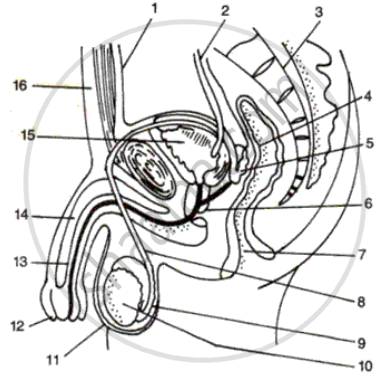
The male reproductive system is a group of organs located in the pelvic region that work together to produce sperm, nourish them, and deliver them into the female reproductive tract.
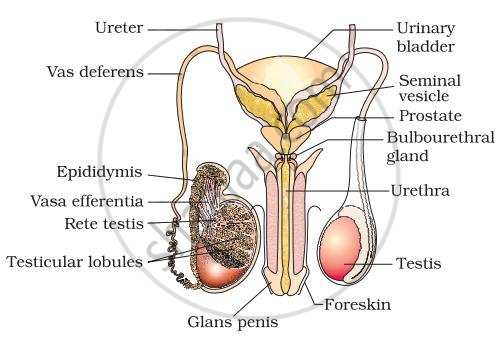
Male Reproductive System
Maharashtra State Board: Class 12
CISCE: Class 12
Components
It consists of four main components:
| Component | Structures Included | Primary Role |
|---|---|---|
| Primary Organs (Gonads) | A pair of testes enclosed in the scrotum | Produce sperm & testosterone |
| Accessory Ducts | Rete testis → Vasa efferentia → Epididymis → Vas deferens → Ejaculatory duct → Urethra | Transport, mature & deliver sperm |
| Accessory Glands | Seminal vesicles (paired), Prostate gland (single), Bulbourethral glands / Cowper's glands (paired) | Produce seminal plasma |
| External Genitalia | Penis | Delivery of sperm; urination |
Maharashtra State Board: Class 12
The Testes
Location & Physical Structure:
- The testes are the primary male sex organs (gonads).
- Located outside the abdominal cavity in a skin pouch called the scrotum.
- The scrotum maintains a temperature 2–2.5°C lower than normal body temperature - essential for spermatogenesis.
- Each testis is oval-shaped: approximately 4–5 cm long and 2–3 cm wide.
- Each testis is covered by a dense covering and divided into approximately 250 compartments called testicular lobules.
- Each lobule contains 1–3 highly coiled seminiferous tubules - the actual sites of sperm production.
Inside the Seminiferous Tubule:
- Spermatogonia (Germ Cells)Produce Sperm: Male germ cells that line the seminiferous tubule. They undergo meiotic divisions to ultimately form spermatozoa (sperm).
- Sertoli Cells (Nurse Cells)Nourish Sperm: Provide nutrition and structural support to developing sperm cells throughout spermatogenesis. Also called "Nurse Cells."
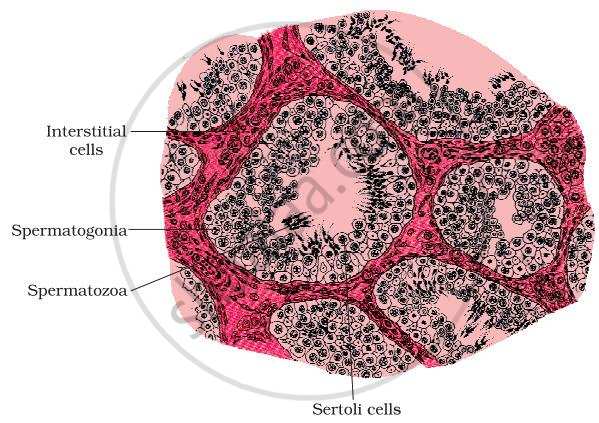
Diagrammatic sectional view of seminiferous tubule
Interstitial Spaces (Outside the Tubules):
| Cell Type | Function |
|---|---|
| Leydig Cells (Interstitial cells) | Secrete androgens (primarily testosterone), the male sex hormone |
| Small blood vessels | Supply nutrients to the tubule cells |
| Immunologically competent cells | Immune defence within the testis |
Maharashtra State Board: Class 12
Path of Sperm - Accessory Ducts
Once sperm are produced in the seminiferous tubules, they travel through a series of ducts.
| Duct | Location / Feature | Key Function |
|---|---|---|
| Rete Testis | Network of fine channels inside the testis | Seminiferous tubules open here; first channel sperm enter |
| Vasa Efferentia | Small ducts leaving the testis | Carry sperm from rete testis to epididymis |
| Epididymis | Posterior (back) surface of each testis; ~6 metres long when uncoiled | Sperm maturation & gain motility; storage (up to ~4 weeks) |
| Vas Deferens | Muscular duct ascending to the abdomen, looping over the ureter | Transport sperm from epididymis towards ejaculatory duct |
| Ejaculatory Duct | Formed by junction of vas deferens + seminal vesicle duct | Carries sperm + seminal vesicle secretion into urethra |
| Urethra | Originates at urinary bladder; runs through penis; opens at urethral meatus | Common pathway for both semen and urine (not simultaneously) |
Maharashtra State Board: Class 12
Accessory Glands - Forming Seminal Plasma
Three glands produce secretions that collectively form the seminal plasma - the fluid component of semen. Their secretions nourish, protect, and mobilise sperm. Semen = Sperm + Seminal Plasma.
| Seminal Vesicles | Prostate Gland | Bulbourethral Glands |
| Paired glands - Posterior to urinary bladder | Single gland - Base of urinary bladder | Paired (Cowper's glands) - Sides of urethra |
| Secretion: Fructose, prostaglandins, proteins. |
Secretion:
Alkaline fluid: zinc, citrate, enzymes.
|
Secretion: Alkaline, mucus-like fluid. |
| Function: Provides energy (fructose) to sperm for motility | Function: Enhances sperm motility; activating enzymes | Function: Lubricates the urethra; neutralises acidic urine residue |
|
60–70%
of total semen volume |
30–40%
of total semen volume |
~5%
of total semen volume |
Seminal plasma is rich in: Fructose, calcium, and certain enzymes - all essential for sperm survival and motility.
Maharashtra State Board: Class 12
External Genitalia - The Penis
- The penis is the male external genitalia.
- Composed of special erectile tissue that enables erection during insemination.
- The enlarged tip is called the glans penis.
- The glans penis is covered by a loose fold of skin called the foreskin (prepuce).
- The urethra runs through the penis and opens at the urethral meatus(external urethral opening).
- The penis serves a dual function: reproduction(delivery of sperm) and excretion (passage of urine).
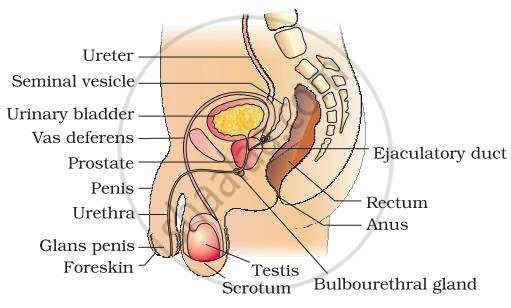
Diagrammatic sectional view of male pelvis showing reproductive system
Maharashtra State Board: Class 12
CISCE: Class 12
Key Points: Male Reproductive System
- The male reproductive system is located in the pelvic region and includes testes, accessory ducts, accessory glands, and external genitalia (penis and scrotum).
- Testes are the primary sex organs present in the scrotum; they contain seminiferous tubules where sperm are produced, while Leydig cells secrete testosterone, and Sertoli cells provide nourishment.
- Accessory ducts - rete testis → vasa efferentia → epididymis → vas deferens → ejaculatory duct → urethra—help in storage, maturation, and transport of sperm.
- Accessory glands - seminal vesicles, prostate gland, and bulbourethral glands - add secretions like fructose, enzymes, and mucus, which nourish sperms and aid in their movement.
- The penis acts as the external genital organ, containing the urethra, and helps in the transfer of sperm during ejaculation.
Test Yourself
Shaalaa.com | Reproduction in Organism
Related QuestionsVIEW ALL [208]
Match the items given in Column I with the most appropriate ones in Column II and rewrite the correct matching pairs:
| Column I | Column II | ||
| (a) | Leydig Cells | 1. | Lack of thyroxine in children |
| (b) | Stoma | 2. | 12 pairs |
| (c) | Ova | 3. | Testosterone |
| (d) | Cranial nerve | 4. | Diffusion of respiratory gases |
| (e) | Cretinism | 5. | Haploid cells |
| 6. | 31 Pairs | ||
| 7. | Diploid cells |