Advertisements
Advertisements
प्रश्न
Briefly describe the process of spermatogenesis.
Explain the process of spermatogenesis in humans.
Advertisements
उत्तर १
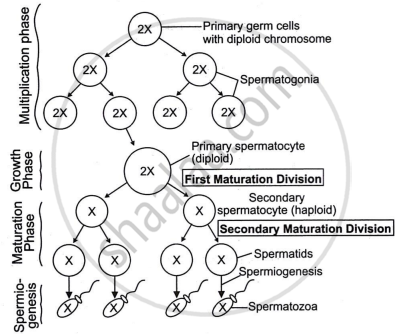
Spermatogenesis is the process of producing spermatogonia from the germinal epithelium (primordial germ cells) via mitosis (multiplication phase). Finally, they stop going through mitosis and mature into primary spermatocytes (growth phase). Each spermatocyte passes through meiosis (the maturation process). The first maturation division is reductional, resulting in two secondary spermatocytes. The latter divides by equational division (second maturation division) to produce four haploid spermatids. Sertoli cells nourish spermatids, which then produce sperm. This process is known as spermiogenesis. During this process, one spermatogonium generates four sperm with half as many chromosomes.
उत्तर २
Spermatogenesis, the process of producing sperms, occurs in the male gonads (testes). The testes have many seminiferous tubules covered with germinal epithelium. Cells of this layer divide to form spermatozoa in the following four steps:
- Multiplication Phase: At sexual maturity, undifferentiated primordial germ cells divide multiple times through mitosis, resulting in a significant number of spermatogonia. Spermatogonia travel to the lumen of seminiferous tubules and begin their growth phase.
- Growth Phase: Spermatogonia evolve into larger spermatocytes by taking food from nursing cells. They are now known as primary spermatocytes.
- Maturation Phase: Primary spermatocytes undergo two divisions, known as maturation divisions. The first maturation division is reductional or meiotic. The original spermatocyte differentiates into two haploid daughter cells, known as secondary spermatocytes. Secondary spermatocytes undergo a second maturation division, resulting in four haploid spermatids from each main spermatocyte.
- Spermiogenesis: This process transforms a circular spermatid into a spermatozoan. Spermatozoa are eventually referred to as sperm. During this process, the nucleus of the spermatid shrinks with tightly packed DNA, and the Golgi apparatus, which contains proteolytic enzymes, forms the acrosomal cap. Axial filaments arise from the distal centriole, while mitochondrial filaments come from the mitochondria. The removal of cytoplasm leaves only a sheath surrounding mitochondria.
APPEARS IN
संबंधित प्रश्न
Draw a diagram of the microscopic structure of human sperm. Label the following parts in it and write their functions:
- Acrosome
- Nucleus
- Middle piece
Name the functions - Acrosome of sperm.
Describe the process of spermatogenesis with the help of diagram.
At the time of birth, there are _______________ oocytes in the ovary of a female foetus.
In angiosperms, the pollen germinates to produce a pollen tube that carries two gametes. What is the purpose of carrying two gametes when a single gamete can fertilize the egg?
The process which the sperm undergoes before penetrating the ovum is ____________.
Define gametogenesis.
The following is the illustration of the sequence of ovarian events (a-i) in a human female.
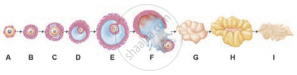
Identify the figure that illustrates ovulation and mention the stage of oogenesis it represents.
Which of the following are known as the nourishing cells present in the seminiferous tubules?
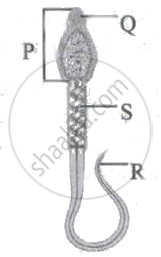
The part labelled as ______ contains the energy source that facilitates sperm motility.
Which of the following correctly describes the secondary oocyte?
Identify the CORRECT sequence of events.
The immature male germ cells differentiates into ______ at the end of meiosis I.
Which of the following events take place during spermatogenesis?
In human beings, the largest cell formed during Oogenesis is ______
Acrosome reaction in sperm is triggered by ______.
By which process sperms released from the seminiferous tubules?
It The cell division in secondary oocyte is suspended at ______.
During embryonic development, the establishment of polarity along anterior/posterior, dorsal/ventral or medial/lateral axis is called ______.
Gray crescent is the area ______.
Besides activating the egg another role of a sperm is to carry ______ to egg.
Preparation of sperm before penetration of ovum is ______.
The head of the epididymis at the head of the testis is called ______.
Layers of an ovum from outside to inside is ______.
Penetration of the sperm in the ovum is followed by ______
Sperms can be stored for several years in liquid nitrogen with a temperature of ______.
The region of the root tip whose cells undergo rapid elongation and enlargement and are responsible for the growth of the root in length is called the:
The number of chromosome groups at the equatorial plate in metaphase-I of meiosis in a plant with 2n = 50 shall be:
Human milk differs from cow's milk because human milk contains:
Which of the following cells during gametogenesis is normally diploid?
During spermatogenesis meiosis occurs in ______.
Process of maturation and development of sperms ______.
Name the germinal layers from which the following organs develop: Tongue, heart, sweat glands, vagina, mammary glands, kidney.
The diagram given below shows the various steps in spermatogenesis.

- Name the parts labelled '1', '2' and '3'.
- Name the process by which part '3' changes to part '4'.
What is spermatogenesis?
The process of gametogenesis is initiated by ______ and ______ hormones respectively.
