Advertisements
Advertisements
प्रश्न
What is parturition?
Advertisements
उत्तर
Parturition is the process of childbirth, which occurs when the development of the foetus is complete in the mother’s womb.
संबंधित प्रश्न
Fill in the blank:
Development of baby (foetus) takes place inside __________.
Differentiate between the following pair:
Uterus and vegina
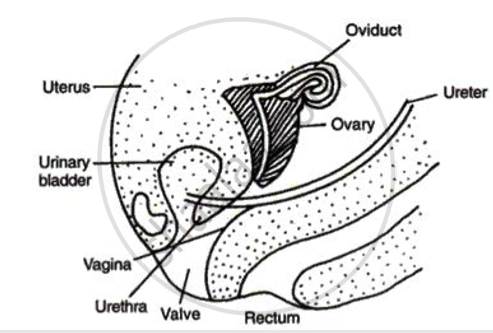
The diagram alongside is the vertical section of female reproductive organs. Study the diagram and answer the questions that follow:
(i) Name the fully developed part of ovary containing the ovum.
(ii) Name the organ of the female body in which the foetus develops.
(iii) What is ovulation?
(iv) Which two hormones are secreted by ovary?
Define the following:
Parturition
Given below is a diagram of the female reproductive system of a human being

(i) Name the parts numbered 1 to 6.
(ii) Normally after how many days does an ovary release an egg?
(iii) Where are the sperms released during coitus?
(iv) What do the sperms do after being released?
(v) What is the function of the organ numbered 5?
(vi) How many days does it normally take from the fertilization of the egg up to the birth of the baby?
The adjoining figure represents the female reproductive organ of the humans
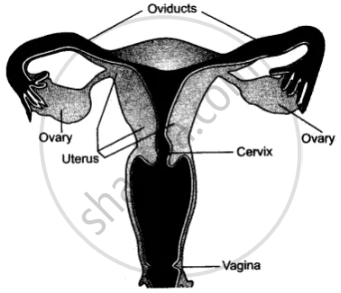
(i) How does the human embryo developing in the uterus obtain its nourishment?
(ii) Which structure protects and nourishes the developing embryo?
(iii) Define ovulation.
Multiple Choice Question:
Corpus luteum in mammals occurs in
Generally, every month, __________ ovum is released in the abdominal cavity alternately from each ovary.
Write the functions of ovary
Womb is used to refer ______.
Primordial follicle cells undergo mitotic division to produce ______.
Contraction of which muscles are responsible for causing labour during parturition?
Identify the layer that makes up the corona radiate.
Stratum germinativum is an example of which kind of epithelium?
The period during adolescence when the reproductive tissues begin to mature is called ______
Read the following and answer from given below:
During copulation, semen is released by the penis into the vegina. The motile sperms swim rapidly, fuse with the ovum in the ampullary region, resulting in fertilization. The haploid nucleus of sperm fuses with that of the ovum to form a diploid zygote.
In the female genital tract, sperms are made capable of fertilizing the egg. This phenomenon of sperm activation is called ______
Read the following and answer from given below:
During copulation, semen is released by the penis into the vegina. The motile sperms swim rapidly, fuse with the ovum in the ampullary region, resulting in fertilization. The haploid nucleus of sperm fuses with that of the ovum to form a diploid zygote.
Select the correct sequence of various physical and chemical events that take place during fertilisation.
P. Fusion of cortical granules with the plasma membrane of secondary oocyte.
Q. Formation of fertilization cone to receive sperm.
R. Release of sperm lysin from acrosome.
S. Mixing up of chromosomes of a sperm and an ovum.
Read the following and answer from given below:
During copulation, semen is released by the penis into the vegina. The motile sperms swim rapidly, fuse with the ovum in the ampullary region, resulting in fertilization. The haploid nucleus of sperm fuses with that of the ovum to form a diploid zygote.
What is the signifacance of fertilisation?
Read the following and answer from given below:
During copulation, semen is released by the penis into the vegina. The motile sperms swim rapidly, fuse with the ovum in the ampullary region, resulting in fertilization. The haploid nucleus of sperm fuses with that of the ovum to form a diploid zygote.
Site of fertilization in human is ______
What changes are observed in the uterus subsequent to the implantation of a young embryo?
How does fertilisation take place? Fertilisation occurs once in a month. Comment.
______ acts as a birth canal.
In which part of the human female reproductive system do the following events take place?
Release of first polar body
In which part of the human female reproductive system do the following events take place?
Release of second polar body
The ______ is also called the womb.
The ______ is also called the womb.
Which part of the fallopian tube is the wider, curved middle section and the site of fertilisation?
