Advertisements
Advertisements
प्रश्न
Which hormones regulate menstrual cycle?
Advertisements
उत्तर
The menstrual cycle is regulated by a complex interplay of hormones such as follicle-stimulating hormone (FSH), luteinising hormone (LH), estrogen, and progesterone. During the follicular phase, levels of FSH and LH secreted from the anterior pituitary begin to rise. FSH, guided by gonadotropin-releasing hormone (GnRH) from the hypothalamus, helps primary follicles grow into Graafian follicles.
As the follicle matures, it begins to secrete estrogen, which leads to the proliferation of the endometrial lining of the uterus. Estrogen also provides positive feedback to stimulate the surge of LH this LH surge causes ovulation, i.e., the rupture of the Graafian follicle and release of the ovum.
The ruptured follicle transforms into the corpus luteum, which secretes progesterone during the luteal phase. Progesterone helps in maintaining the endometrium and preparing it for possible implantation of the embryo.
If fertilisation does not occur, progesterone levels drop, the corpus luteum degenerates, and the endometrium sheds, marking the onset of menstruation. High levels of progesterone also inhibit FSH and LH, thereby preventing further ovulation in that cycle.
APPEARS IN
संबंधित प्रश्न
Explain the menstrual phase in a human female. State the levels of ovarian and pituitary hormones during this phase.
Explain the events that occur in a graafian follicle at the time of ovulation and thereafter.
the Biological/technical term for Complete stoppage of menstrual cycle in females
Define Amenorrhea
What is menstrual cycle? Describe it in brief.
Sketch the labelled diagram.
Menstrual cycle
Choose the correct answer from the four options given below :
On which day of the menstrual cycle does ovulation take place ?
Define Menarche.
Explain the role of hormones during the menstrual cycle.
The menstrual cycle ceases during pregnancy.
Answer the following type of question Assertion (A) and Reason (R).
(A) - Ovulation is the release of the ovum from the Graafian follicle.
(R) - It occurs during the follicular phase of the menstrual cycle.
During which phase of the menstrual cycle does the endometrium thicken up to 8-10 mm?
In humans, the menstrual cycle is generally of ______.
In the absence of fertilization, corpus luteum ____________.
Choose the correct order of phases of the menstrual cycle.
The temporary endocrine gland in humans is ______.
Calculate the expected date of ovulation, if in a normal menstruating woman, gets her menses on 5th April.
Luteal phase is also known as ____________.
The mammalian corpus luteum produces ______.
Mainly which type of hormones control the menstrual cycle in human beings?
Mature Graafian follicle is generally present in the ovary of a healthy human female around stet ______.
Exit from the cell cycle and remain dormant for long time by a cell is represented by one of the following phases of the cell cycle:
The Corpus luteum grows during menstruation.
Define ovulation.
In the figure given below, parts A and B show the level of hormones which influence the menstrual cycle. Study the figure and answer the questions that follow:
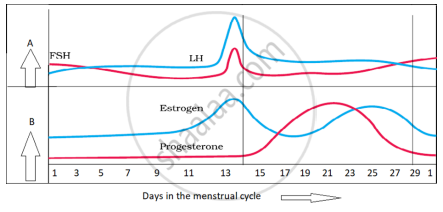
- Name the organs which secrete the hormones represented in parts A and B.
- State the impact of the hormones in part B on the uterus of the human female during 6 to 15 days of the menstrual cycle.
Answer the following questions by observing the diagram of menstrual cycle:

- What is the period of menstruation?
- On which day does ovulation occur during the menstrual cycle?
- In the menstrual cycle which reproductive organs undergo changes?
- Which period is said to be the period of regeneration of endometrium?
- Which period is said to be the period of secretions of glands in endometrium?
The onset of menstruation in a human female is called ______.
The first menstruation is called ______.
Which of the following statements are correct regarding female reproductive cycle?
- In non-primate mammals cyclical changes during reproduction are called oestrus cycle.
- First menstrual cycle begins at puberty and is called menopause.
- Lack of menstruation may be indicative of pregnancy.
- Cyclic menstruation extends between menarche and menopause.
Choose the most appropriate answer from the options given below:
What is the average duration of the menstrual cycle?
