Advertisements
Advertisements
प्रश्न
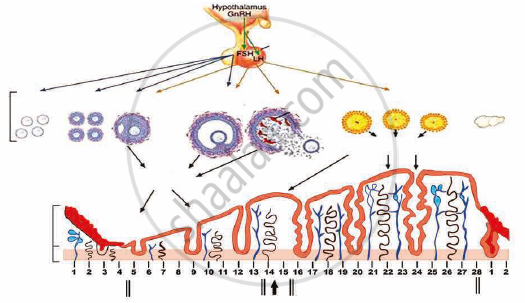
Explain the changes that occur in the ovary and uterus during menstrual cycle in human females. Mention the influence of pituitary and ovarian hormones in bringing these changes.
Advertisements
उत्तर
Menstrual phase (1-5)
Endometrium breaks down the cell of endometrium secretions unfertilised ovum constitute menstrual flow. Progesteron production is reduced
Follicular Phase (6-13 days)
Endometrium rebuilds, FSH and oestrogen secretion is increased.
Ovulatory Phase (14-16 days)
Both LH and FSH attain peak level. Estrogen level is also high. It leads to ovulation.
Luteal Phase (16-28 days)
In absence of fertilisation corpus luteum secretes progesterone. Endometrium thickens and uterine glands become secretary.
The menstrual cycle starts with the menstrual phase, when menstrual flow occurs and it lasts for 3-5 days. It results due to breakdown of endometrial lining of the uterus and its blood vessels.
Follicular Phase The menstrual phase is followed by the follicular phase.
During this phase, the primary follicles in the ovary grow to become a fully mature Graafian follicle and simultaneously the endometrium of uterus regenerates through proliferation. These changes in the ovary and the uterus are induced by changes in the levels of pituitary and ovarian hormones.

The secretion of gonadotropins (LH and FSH) increases gradually during the follicular phase and stimulates follicular development as well as secretion of estrogens by the growing follicles. Both LH and FSH attain a peak level in the middle of cycle (about 14th day).
Rapid secreation of LH leading to its maximum level during the mid-cycle called LH surge induces rupture of Graafian follicle and thereby the release of ovum (ovulation). The ovulation (ovulatory phase) is followed by the luteal phase during which the remaining parts of the Graafian follicle transform as the corpus luteum. The corpus luteum secretes large amounts of progesterone which is essential for maintenance of the endometrium.
Such an endometrium is necessary for implantation of the ferillised ovum and other events of pregnancy. In the absence of fertilisation, the corpus luteum degenerates.
This causes disintegration of the endometrium leading to menstruation.
APPEARS IN
संबंधित प्रश्न
Why is follicular phase in the menstrual cycle also referred as proliferative phase? Explain.
What is menstrual cycle? Describe it in brief.
Observe the figure and answer the questions given below.
a) What does the above figure indicate?
b) Which human organs are involved in this process?
c) Name the hormones responsible for this process.
d) After how many days these repetitive changes take place?
e) ‚A woman should stay away from others, as her body is impure during this process.‛ What is your opinion about this statement? Elaborate it.
Give Reasons
The chances of pregnancy to occur are most favourable on or about the 14th day of the menstrual cycle. Explain.
Luteal phase is also known as ____________.
Secretion of progesterone by corpus luteum is initiated by ______.
Ovulation in the human female normally takes place during the menstrual cycle ______.
Withdrawal of which of the following hormones is the immediate cause of menstruation?
What are the events taking place in the ovary and uterus during follicular phase of the menstrual cycle.
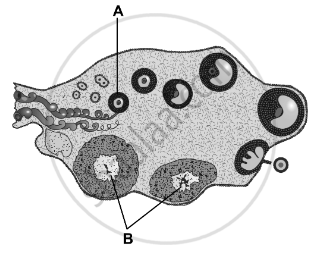
The figure show a section of human ovary. Select the option which gives the correct identification of either A or B with function/characteristic.