Advertisements
Advertisements
प्रश्न
Humans reproduce ______.
पर्याय
asexually
sexually
Advertisements
उत्तर
Humans reproduce sexually.
Explanation:
Humans are sexually reproducing and viviparous. The reproductive events in humans include the formation of gametes (gametogenesis), i.e., sperm in males and ovum in females; the transfer of sperm into the female genital tract (insemination); and the fusion of male and female gametes (fertilisation), leading to the formation of a zygote.
APPEARS IN
संबंधित प्रश्न
List two functions performed by the testis in human beings.
What are the major components of seminal plasma?
Give appropriate biological/technical terms for the following:
The accessory gland in human males whose secretion activates the
sperms.
Differentiate between Rod cells and cone cells (pigment)
State the function of Seminal vesicle.
Write in sequence, the regions which a mature sperm travels from the seminiferous tubules up to the urethral opening in the human male.
Describe the functions of the following:
ovary
What are the accessory reproductive organs?
Differentiate between vas deferens and vasa efferentia.
Complete the following sentences with appropriate word:
The surgical sterilization of males is known as _________.
Draw a neat and labelled diagram.
Human male reproductive organs
Identify the INCORRECTLY labelled structure in the given diagram of the male reproductive system.
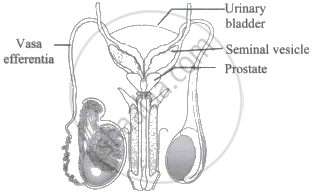
Which is the duct that carries sperms from testes and opens into the epididymis?
Identify the approximate number of lobules present in the testis.
Failure of testes to descend from abdomen into scrotum leads to ______.
The correct sequence of spermatogenetic stages leading to the formation of sperms in a mature human testis is ______.
Give two reasons for the appearance of variations among the progeny formed by sexual reproduction.
Which one of the following is not a male accessory gland?
Given below is a certain situation. Analyze and describe its possible impact on a person:
The Vas deferens of a man is plugged.
Answer the following question based on the human male reproductive system:
By which type of cell division, sperms are formed?
The male accessory gland whose secretion neutralizes the acidity of the urethra and vagina is ______.
The canal through which each testis descends into the scrotum just before the birth of a male baby is ______.
Write important function of the following:
Testis
Can there be any abnormal situation regarding testes location? If so, what is that and what is the harm caused due to it?
The bulbourethral glands (Cowper's glands) are paired glands located at which anatomical position?
What is the composition of semen in terms of its cellular and fluid components?
The penis is composed of which type of tissue that enables erection during insemination?
