Advertisements
Advertisements
Question
How many eggs are released by a human ovary in a month? How many eggs do you think would have been released if the mother gave birth to identical twins? Would your answer change if the twins born were fraternal?
Advertisements
Solution
Each ovary produces several immature eggs, which are connected with groups of other cells known as follicles. In humans, only one egg is usually removed at a time; however, two or more may emerge during the menstrual cycle. The egg emerges from the ovary between the 14th and 16th days of the typically 28-day menstrual cycle. Fertilisation of a single egg results in one zygote (monozygotic) that divides into two embryos, forming identical twins. If the twins were born fraternal, two eggs would be released. Fraternal twins (also known as non-identical twins) are typically formed when two fertilised eggs are implanted in the uterine wall at the same time. The two eggs produce two zygotes; hence, these twins are also known as dizygotic or binovular twins.
APPEARS IN
RELATED QUESTIONS
Why does menstruation occur?
Choose the odd one in each of the following:
Ovary; fallopian tube; ureter; uterus
Choose the odd one in each of the following:
Sperm; implantation; fertilization; ovum; ovum; after birth.
Explain with examples types of asexual reproduction in unicellular organisms.
The diagram given below represents a system in the human body. Stud the diagram and answer the following questions: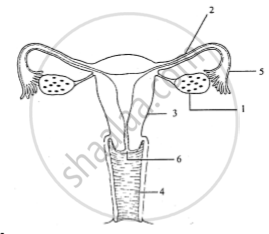
Identify the system
The diagram given below represents a system in the human body. Stud the diagram and answer the following questions: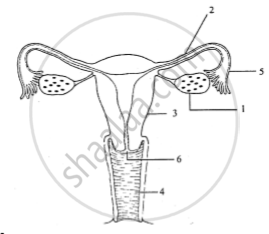
Label the parts marked 5 and 6.
The diagram given below represents a system in the human body. Stud the diagram and answer the following questions: 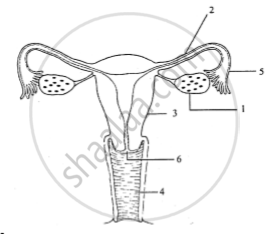
Mention the number and the name of the part involved in fertilization and implantation from the above diagram.
Give appropriate term of the following:
The rupture of follicle and release of ovum from the ovary.
The diagram alongside is the vertical section of female reproductive organs. Study the diagram and answer the questions that follow:
(i) Name the fully developed part of ovary containing the ovum.
(ii) Name the organ of the female body in which the foetus develops.
(iii) What is ovulation?
(iv) Which two hormones are secreted by ovary?
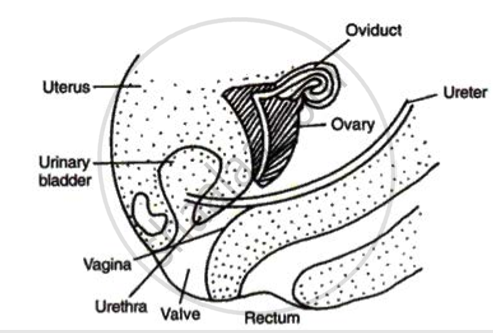
Name the following:
The organ of female in which the foetus develops.
Name the following:
The separation of the foetus from the mother's body.
Name the following:
The part of the female reproductive system in which fertilization occurs.
Give the functions of the following:
Penis
Given here is a section of the female reproductive system of human beings.
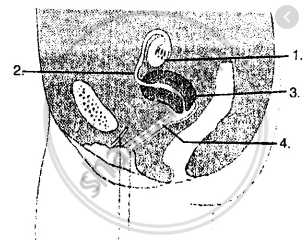
Name the part where fertilisation occurs in human beings.
Draw a label diagram.
Draw a sectional view of the human ovary showing the different stages of developing follicles, corpus luteum, and ovulation.
Name the Following
The term used for the mature follicles.
Give Technical Term:
Name the tube that leads from the ovary to the uterus.
Multiple Choice Question:
Sterilization in the female involves cuffing and tying the
The largest cell in the human body of a female is ______.
After fertilization the ovary develops into ______.
What is the other term used for fallopian tube?
Penis is homologous to ____________.
Ovulation occurs under the influence of ______.
The estrus cycle is a characteristic of ______.
The ability to reproduce is lost in a female after ______
Where does fertilization take place?
Read the following and answer from given below:
Oogenesis is the process of the formation of an ovum in the ovaries. It consists of three phases: multiplication, growth, and maturation. Oogenesis is controlled by hormones GnRH, LH, FSH. GnRH secreted by the hypothalamus stimulates the anterior lobe of the pituitary gland to secrete LH and FSH.
Which hormone induces the rupture of the mature Graafian follicle?
What is the other name for fallopian tubes?
Rewrite the terms in the correct order so as to be in a logical sequence.
Sperm duct, coitus, sperm, vagina, urethra.
The ______ is also called the womb.
