Advertisements
Advertisements
Questions
In our society the women are often blamed for giving birth to daughters. Can you explain why this is not correct?
Women are often blamed for producing female children. Consequently, they are ill-treated and ostracized. How will you address this issue scientifically if you were to conduct an awareness programme to highlight the values involved?
Advertisements
Solution
Blaming women in our society for having girls is incorrect because the father determines the sex of the baby, not the mother. As we all know, the human female chromosome pattern is XX, while the male is XY. As a result, all haploid gametes produced by the female (ova) have the sex chromosome X, whereas male gametes (sperms) can have either X or Y; therefore, 50% of sperms carry the X chromosome, and the other 50% have the Y. Following the fusing of the male and female gametes, the zygote would bear either XX or XY depending on whether the sperm carrying X or Y fertilized the ovum. The zygote bearing XX would produce a female baby, while XY would produce a male. As a result, the baby’s sex is determined by male sperm rather than female ova.
Notes
Students should refer to the answer according to their questions.
APPEARS IN
RELATED QUESTIONS
Explain the development of a secondary oocyte (ovum) in a human female from the embryonic stage upto its ovulation. Name the hormones involved in this process.
The process of release of the ovum from a mature follicle is called ______.
Name the functions - Acrosome of sperm.
Multiple choice question.
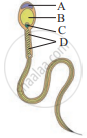
The given figure shows human sperm. Various parts of it are labelled as A, B, C, and D. Which labelled part represents acrosome?
Describe the process of spermatogenesis with the help of diagram.
At the time of birth, there are _______________ oocytes in the ovary of a female foetus.
In angiosperms, the pollen germinates to produce a pollen tube that carries two gametes. What is the purpose of carrying two gametes when a single gamete can fertilize the egg?
If one pollen grain produces two male gametes, how many pollen grains are needed to fertilize 10 ovules?
The following is the illustration of the sequence of ovarian events (a-i) in a human female.
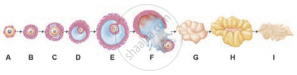
Identify the figure that illustrates ovulation and mention the stage of oogenesis it represents.
Identify the CORRECT sequence of events.
Which of the following events take place during spermatogenesis?
How many autosomes does a human primary spermatocyte have?
It The cell division in secondary oocyte is suspended at ______.
Corona radia is made up of ______.
Identify the wrong statement from the following.
Spermiation is the process of the release of sperm from ______.
Cavity of graafian follicle is ______.
Which of the following contains the actual genetic part of a sperm?
Select the correct sequence of stages of spermatogenesis in a human male ______.
Sperms can be stored for several years in liquid nitrogen with a temperature of ______.
Human milk differs from cow's milk because human milk contains:
Which of the following cells during gametogenesis is normally diploid?
During reproduction, the chromosome number (2n) reduces to half (n) in the gametes and again the original number (2n) is restored in the offspring. What are the processes through which these events take place?
During spermatogenesis meiosis occurs in ______.
Draw a labelled diagram of a section through the ovary.
During oogenesis the meiotic division is arrested at ______ before fertilization.
In which structures does spermatogenesis occur?
