Advertisements
Advertisements
प्रश्न
How many eggs are released by a human ovary in a month? How many eggs do you think would have been released if the mother gave birth to identical twins? Would your answer change if the twins born were fraternal?
Advertisements
उत्तर
Each ovary produces several immature eggs, which are connected with groups of other cells known as follicles. In humans, only one egg is usually removed at a time; however, two or more may emerge during the menstrual cycle. The egg emerges from the ovary between the 14th and 16th days of the typically 28-day menstrual cycle. Fertilisation of a single egg results in one zygote (monozygotic) that divides into two embryos, forming identical twins. If the twins were born fraternal, two eggs would be released. Fraternal twins (also known as non-identical twins) are typically formed when two fertilised eggs are implanted in the uterine wall at the same time. The two eggs produce two zygotes; hence, these twins are also known as dizygotic or binovular twins.
APPEARS IN
संबंधित प्रश्न
Put a tick mark (✓) against the correct alternative in the following statement:
Internally, the uterus opens into:
Given here is a section of the female reproductive system of human beings.
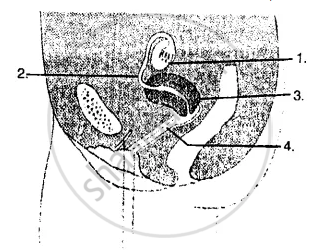
Name the parts labelled 1 to 4
Fill in the blank:
Lower part of uterus is called _________.
Choose the odd one in each of the following:
Seminiferous tubule; ovum; epididymis; sperm duct; urethra
Choose the odd one in each of the following:
Sperm; implantation; fertilization; ovum; ovum; after birth.
Rewrite the terms in the correct order so as to be in a logical sequence.
Graafian follicle, ostium, uterus, fallopian tube.
What is hymne?
The below diagram represents the sectional view of the female reproductive organs of a mammal.

(i) Label the parts numbered 1 to 7.
(ii) What are the main functions of the parts labeled 2, 5, 6?
Explain the term Tubectomy.
Name the Following
The age or period when the reproductive organs become fully operational.
Name the Following
The hormone that stimulates the contraction of the uterus during childbirth.
Give Technical Term:
Name the tube that leads from the ovary to the uterus.
Write the functional activity of the following structure:
Inguinal canal
Generally, every month, __________ ovum is released in the abdominal cavity alternately from each ovary.
Match the parts of the given figure with the correct option.
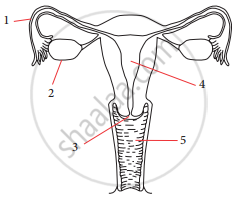
| 1 | 2 | 3 | 4 | 5 | |
| a. | Fallopian tube | Oviduct | Uterus | Cervix | Vagina |
| b. | Oviduct | Cervix | Vagina | Ovary | Vas deferens |
| c. | Ovary | Oviduct | Uterus | Vagina | Cervix |
| d. | Fallopian tube | Ovary | Cervix | Uterus | Vagina |
Estrogen is secreted by ______
After fertilization the ovary develops into ______.
The birth canal is formed by ______.
During which process is the egg released from the Graafian follicle?
Which of the following is ectodermal in origin?
| (i) | Heart |
| (ii) | Sweat glands |
| (iii) | Adrenal medulla |
| (iv) | Middle ear |
| (v) | Urinary bladder |
| (vi) | Dermis of skin |
In human females, an event that reflects onset of reproductive phase is
What is the other name for fallopian tubes?
What are the functions of the ovaries and uterus in the female reproductive system?
______ is not a part of the female reproductive system in human beings.
Bartholin's glands are homologous to ______.
The______ is also called the womb.
Rewrite the terms in the correct order so as to be in a logical sequence.
Graafian follicle, ostium, uterus, fallopian tube, ovum.
Write the specific location of the following:
Uterus
Write the specific location of the following:
Vagina
Statement I: The presence or absence of hymen is not a reliable indicator of virginity.
Statement II: The hymen is torn during the first coitus only.
In the light of the above statements, choose the correct answer from the options given below:
