Advertisements
Advertisements
Question
The below diagram represents the sectional view of the female reproductive organs of a mammal.

(i) Label the parts numbered 1 to 7.
(ii) What are the main functions of the parts labeled 2, 5, 6?
Advertisements
Solution
(i)
(1) Fallopian tube
(2) Fimbriated funnel
(3) Ureter
(4) Vagina
(5) Ovary
(6) Uterus
(7) Urinary bladder
(ii)
2 - Funnel. It collects ovum by us ciliary movement.
5-Ovary. It produces ovum.
6-Uterus. It lodges and nourishes ovum.
RELATED QUESTIONS
Name the Following
The age or period when the reproductive organs become fully operational.
Write the functional activity of the following structure:
Fallopian tubes
The largest cell in the human body of a female is ______.
The implantation of the embryo occurs at about ______ days of fertilization.
The birth canal is formed by ______.
Which stage is followed after the secondary follicle stage?
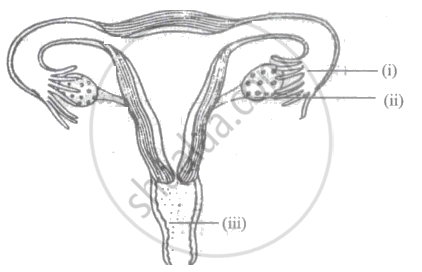
Identify the labels (i, ii and iii) in the given diagram of the female reproductive system.
The diagram given below shows a section of the human ovary.
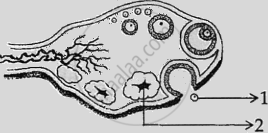
- Name the process for the release of the part labelled 1.
- Write the name of the structure marked 2.
Median vertical depression of external genitalia in females, enclosing the urethral and vaginal opening is ______.
Complete the analogy with respect to reproductive system.
Male : Penis : : Female : ______.
