Advertisements
Advertisements
Question
Why does menstruation occur?
Advertisements
Solution
Menstruation is a process in which blood and mucous flow out every month through the vagina. This process occurs every month because one egg is released from the ovary every month and at the same time, the uterus (womb) prepares itself to receive the fertilised egg. Thus, the inner lining of the uterus gets thickened and is supplied with blood to nourish the embryo. If the egg does not get fertilised, then the lining of the uterus breaks down slowly and gets released in the form of blood and mucous from the vagina. It lasts for three to five days.
APPEARS IN
RELATED QUESTIONS
Given here is a section of the female reproductive system of human beings.
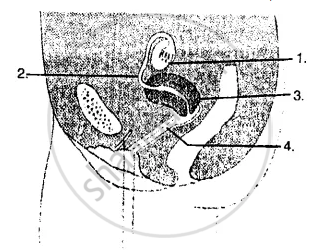
Name the parts labelled 1 to 4
Fill in the blank:
The time between fertilisation and birth is called _________.
Mention the functions of Ovary.
Give the appropriate term for the following:
Monthly discharge of blood and disintegrated tissues in the human female
Complete the paragraph with the help of words given in the bracket.
(Luteinizing hormone, endometrium of uterus, follicle stimulating hormone, estrogen, progesterone, corpus luteum)
Growth of follicles present in the ovary occurs under the effect of ______. This follicle secretes estrogen. ______ grows/regenerates under the effect of estrogen. Under the effect of ______, fully grown up follicle bursts, ovulation occurs and ______ is formed from remaining part of follicle. It secrets ______ and ______. Under the effect of these hormones, glands of ______ are activated and it becomes ready for implantation.
Mention the exact location of the following :
Corpus callosum
The diagram alongside is the vertical section of female reproductive organs. Study the diagram and answer the questions that follow:
(i) Name the fully developed part of ovary containing the ovum.
(ii) Name the organ of the female body in which the foetus develops.
(iii) What is ovulation?
(iv) Which two hormones are secreted by ovary?
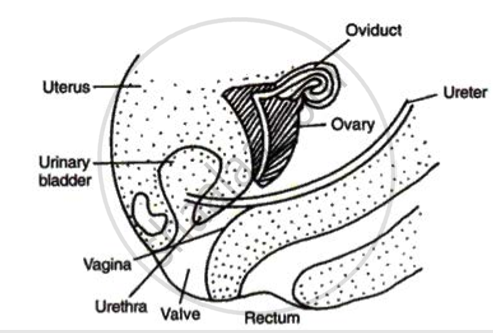
Name the following:
The organ of female in which the foetus develops.
Define the following:
Parturition
The adjoining figure represents the female reproductive organ of the humans
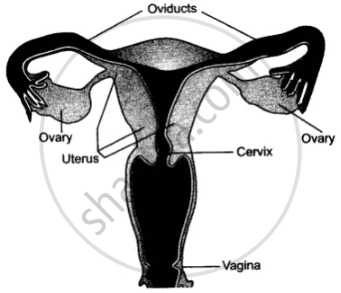
(i) How does the human embryo developing in the uterus obtain its nourishment?
(ii) Which structure protects and nourishes the developing embryo?
(iii) Define ovulation.
Name the Following
The age or period when the reproductive organs become fully operational.
Give Technical Term:
What term is used for the production and maturation of eggs in the ovaries?
Give Technical Term:
Which part develops during the advanced pregnancy?
Write the functional activity of the following structure:
Graafian follicle
Generally, every month, __________ ovum is released in the abdominal cavity alternately from each ovary.
Name the part of the human female reproductive system where the following occurs.
Implantation
Which of the following are accessory ducts of female reproductive system?
All are associated with ovulation in human female, EXCEPT
Which of the following is ectodermal in origin?
| (i) | Heart |
| (ii) | Sweat glands |
| (iii) | Adrenal medulla |
| (iv) | Middle ear |
| (v) | Urinary bladder |
| (vi) | Dermis of skin |
Ovulation occurs under the influence of ______.
Stratum germinativum is an example of which kind of epithelium?
Which one is correct for mammalian testis?
Lower narrow end of uterus is called ______.
The finger-like projections, called fimbriae, help in the collection of ovum into the fallopian tube following ovulation.
Mark the odd one.
How does fertilisation take place? Fertilisation occurs once in a month. Comment.
What is parturition?
Explain how the uterus and placenta provide necessary conditions for proper growth and development of the embryo after implantation?
Give reason.
Placenta is extremely essential for foetal development.
Bartholin's glands are homologous to ______.
Given below is a certain situation. Analyze and describe its possible impact on a person:
Placenta does not attach to the uterus optimally.
Describe the female reproductive systems in humans.
Rewrite the terms in the correct order so as to be in a logical sequence.
Graafian follicle, ostium, uterus, fallopian tube, ovum.
Given below is a group of terms. In the group, one pair indicates the relationship between the two terms. Rewrite and complete the second pair on a similar basis.
Leydig cells : Testosterone : ______ : Oestrogen.
Which steroid/ovarian hormones are produced by the ovaries?
What connects the embryo to the mother for nutrient and waste exchange till birth?
What do mammary glands produce to nourish the offspring after birth?
Which statement correctly describes the basic composition of each breast?
