Advertisements
Advertisements
Questions
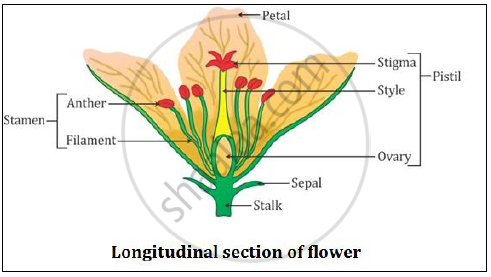
Draw a diagram of the longitudinal section of a flower and label the following parts.
Draw a labelled diagram of the longitudinal section of a flower.
Draw a well-labelled diagram of the longitudinal section of a flower.
Advertisements
Solution 1
Longitudinal section of a flower:
Solution 2

Longitudinal section of flower
RELATED QUESTIONS
In the following diagram showing the structure of embryo of a dicot seed, what are the parts marked I, II and III sequentially?

A student while observing an embryo of a pea seed in the laboratory listed various parts of the embryo as given below:
Testa, Tegmen, Radicle, Plumule, Micropyle, Cotyledon.
On examining the list the teacher remarked that only three parts are correct. Select three correct parts from the above list:
(a) Testa, Radicle, Cotyleddon
(b) Tegmen, Radicle, Micropyle
(c) Cotyledon, Plumule, Testa
(d) Radicle, Cotyledon, Plumule
Name and differentiate between the two modes of pollination in flowering plants.
Mention the changes a flower undergoes after fertilisation.
State the name of the functional unit concerned with sexual reproduction.
Where are the pollen grains produced?
Fill in the following blank with suitable word :
Pollen grains contain ............ gametes of a plant.
Fill in the following blank with suitable word :
The ovary of a flower becomes ....... after fertilisation.
Fill in the following blank with suitable word :
The name of the structure in the flower in which the male gamete is formed is...........
Explain the terms 'self pollination'
Explain the term 'fertilisation'.
What type of plants reproduce by sexual reproduction method?
How does pollination occur?
What changes take place in the flower after fertilisation which lead to the formation of seeds and fruit?
Which of the following is the correct sequence of events of sexual reproduction in a flower?
(a) pollination, fertilisation, seed, embryo
(b) seed, embryo, fertilisation, pollination
(c) pollination, fertilisation, embryo, seed
(d) embryo, seed, pollination, fertilisation
Which of the following statements are true for sexual reproduction in flowering plants?
(i) it requires two types of gametes
(ii) fertilisation is a compulsory event
(iii) it always results in the formation of zygote
(iv) offsprings formed are clones
(a) (i) and (iv)
(b) (i), (ii) and (iv)
(c) (i), (ii) and (iii)
(d) (ii), (iii) and (iv)
In what ways is fertilisation in a plant different from fertilisation in a human?
Fill in the blank by selecting suitable word:
A flower bearing only male or female parts is known as __________ flower.
Draw a diagram of the longitudinal section of a flower exhibiting germination of pollen on stigma and label (i) ovary, (ii) male germ-cell, (iii) female germ-cell and (iv) ovule on it.
Explain the process of fertilisation in flowers.
A student is asked to study the different parts of an embryo of pea seeds. Given below are the essential steps for the experiment :
(I) Soak the pea seeds in plain water and keep them overnight.
(II) Cut open the soaked seed and observe its different parts.
(III) Take some pea seeds in a petri dish.
(IV) Drain the excess water. Cover the seeds with a wet cotton cloth and leave them as it is for a day.
The correct sequence of these steps is
(A) III, I, IV, II
(B) III, IV, I, II
(C) III, I, II, IV
(D) III, II, I, IV
(a) Identify A, B and C in the given diagram and write their functions.
(b) Mention the role of gamete and zygote in sexually reproducing organisms.
Explain sexual reproduction in plants.
Answer the following question.
List two agents of pollination?
Bisexual : Hibiscus : : Unisexual : ___________
Write the functions of sepals
Distinguish between self-pollination and cross-pollination.
Explain the sexual reproduction process in plants with a diagram.
Write the events involved in the sexual reproduction of a flowering plant.
Discuss the first event and write the types.
The ovule of an angiosperm is technically equivalent to ______
Gloriosa superba exhibits ______.
Sperm and egg nuclei fuse due to ______.
Length of pollen tube depends on the distance between ______
Trace the path a male gamete takes to fertilise a female gamete after being released from the penis.
Give any two examples of agents of pollination.
In a plant flower the female whorl is ______.
What are the agents for pollination?
What is the function of calyx?
Consider the following three flowers namely X, Y and Z. Which flower(s) would develop into a fruit?
| Flower X | Flower Y | Flower Z |
 |
 |
 |
