Advertisements
Advertisements
Question
Mature ovary forms the ______.
Options
seed
stamen
pistil
fruit
Advertisements
Solution
Mature ovary forms the fruit.
Explanation:
After fertilization, the ovary develops and transforms into a fruit, which encases and protects the seeds until they are ready for dispersal.
APPEARS IN
RELATED QUESTIONS
A student was asked to observe and identify the various parts of an embryo of a red kidney bean seed. He identified the parts and listed them as under:
I. Tegmen
II. Testa
III. Cotyledon
IV. Radicle
V. Plumule
The correctly identified parts among these are
(A) I, II and III
(B) II, III and IV
(C) III, IV and V
(D) I, III, IV and V
Mention the changes a flower undergoes after fertilisation.
Explain what you understand by sexual reproduction.
Fill in the following blank with suitable word :
The name of the structure in the flower in which the male gamete is formed is...........
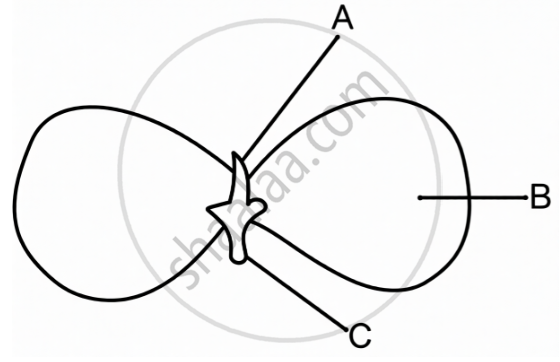
In the figure given alongside, the parts marked A, B and C are sequentially:
Multiple choice question. Tick (✓) the correct choice:
Unisexual flowers are found in
- mulberry
- mustard
- pea
- sunflower
What part is played by stamens and carpels in reproduction?
Prepare a slogan for campaign against female foeticide.
Complete the table
| Carly x | ______ | ______ |
| ______ | petal | attract insects |
| Androecium | ______ | Male reproductive part |
| ______ | ______ | Female reproductive part. |
The figure below shows the concept of double fertilization. Complete the flow chart showing the progress at each step:

