Advertisements
Advertisements
Question
Define.
Inflorescence
Advertisements
Solution
A specialised axis or branch over which flowers are produced or borne in definite manner is known as inflorescence.
APPEARS IN
RELATED QUESTIONS
A student while observing an embryo of a pea seed in the laboratory listed various parts of the embryo as given below:
Testa, Tegmen, Radicle, Plumule, Micropyle, Cotyledon.
On examining the list the teacher remarked that only three parts are correct. Select three correct parts from the above list:
(a) Testa, Radicle, Cotyleddon
(b) Tegmen, Radicle, Micropyle
(c) Cotyledon, Plumule, Testa
(d) Radicle, Cotyledon, Plumule
A student has to perform the experiment "To identify the different parts of an embryo of a dicot seed." Select from the following an appropriate group of seeds:
(a) Pea, gram, wheat
(b) Red kidney bean, maize, gram
(c) Maize, wheat, red kidney bean
(d) Red kidney bean, pea, gram
State significance of pollination.
State the function of flowers in the flowering plants.
What are the reproductive organs in a flower?
What is the name of female part of a flower?
Fill in the following blank with suitable word :
The ovule becomes a .......... after fertilisation.
Fill in the following blank with suitable word :
The female organ of reproduction in the flower is the...........
Draw a neat sketch of the carpel of a flower. Mark in it stigma, style and ovary.
Explain the term 'fertilisation'.
Name the part of a seed which contains stored food.
Draw a neat diagram of a flower showing its various parts. In this diagram mark stem, receptacle, sepals, petals, stamen and carpel.
The correct sequence of reproductive stages occurring in flowering plants is ______.
The part of a seed which grows and develops into root on germination is :
(a) cotyledon
(b) plumule
(c) follicle
(d) radicle
The flask-shaped organ A at the centre of a flower is surrounded by a number of little stalks B having swollen tops which lie just inside the ring of petals.
(a) Name A. What are the various parts of A?
(b) Which part of A contains gametes?
(c) Name B. What is the swollen top of B known as?
(d) What does the swollen top of b contain?
(e) Out of A and B, which one is (i) male part, and (ii) female part of the flower?
In a bisexual flower, inspite of the young stamens being removed artificially, the flower produces fruit. Explain.
Fill in the blanks:
A carpel consists of ________ , ________ and ________.
State whether the following statement is true (T) or false (F):
Flowers which possess stamens and carpel are called unisexual.
Draw a diagram of the longitudinal section of a flower exhibiting germination of pollen on stigma and label (i) ovary, (ii) male germ-cell, (iii) female germ-cell and (iv) ovule on it.
List any two differences between pollination and fertilization.
Answer the following question.
How does suitable pollination lead to fertilization?
Find an odd one out.
Pollen grains from anther are transferred to the stigma.
Identify the parts A, B, C, and D?
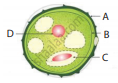
Which of the following is the outermost protective layer of anther?
What would be the number of chromosomes of the aleurone cells of a plant with 42 chromosomes in its roots tip cells?
In a flowering plant, archesporium gives rise to ______.
What would be the number of chromosomes in the cells of the aleurone layer in a plant species with 8 chromosomes in its synergids?
Variations occur as a result of ______
Which out of the following processes does not lead to the formation of clones.
Which among the following statements are true for sexual reproduction in flowering plants?
- It requires two types of gametes
- Fertilisation is a compulsory event
- It always results in formation of zygote
- Offspring formed are clones
In a bisexual flower inspite of the young stamens being removed artificially, the flower produces fruit. Provide a suitable explanation for the above situation.
Give reason for the following:
Fertilization cannot take place in flowers if pollination does not occur.
Where is the zygote located in the flower after fertilization?
Triple fusion involves ______.
Given below is a diagram of a germinating seed. Label the parts that:
- gives rise to future shoot.
- gives rise to future root system.
- stores food.
- Assertion: Primary endosperm nucleus is diploid.
- Reason: It is the product of double fertilisation.
The number of pollen sacs in a dithecous anther is ______.
