Advertisements
Advertisements
Question
Give one example each of unisexual and bisexual flowers. Differentiate between the two types of pollination that occur in flowers. What happens when a pollen lands on a suitable stigma? Write about the events that occur till the seed formation in the ovary.
Advertisements
Solution
An example of unisexual flower is papaya and that of bisexual flower is Hibiscus.
Two types of pollination may occur in flowers: self pollination and cross pollination. Some major differences betwen the two are as follows:
Self Pollination Cross Pollination
It involves the transfer of pollen grains from anther to the stigma of the same flower. It involves the transfer of pollen grains from the anther to the stigma of another flower.
It may not require any external agency for the transfer of pollen grains. It always requires an external agency for the transfer of pollen grains.
It doesn't bring variations. It brings a number of variations.
When a pollen lands on a suitable stigma, it absorbs water, swells and then germinates to give rise to pollen tube. This pollen tube eventually grows and passes through the style towards the ovary. During the growth of the pollen tube, two male gametes are formed inside the tube. When it reaches the ovary, the pollen tube enters the ovule through micropyle. The tip of the tube ruptures to release the two male gametes into the embryo sac. One of the male gamete fuses with the egg to form diploid zygote (fertilisation). The other male gamete fuses with the two polar nuclei to form triploid primary endosperm nucleus (triple fusion).
After fertilisation, the zygote divides mitotically and transform into multicellular embryo. The endosperm also divides and grows in size to provide adequate nutrition to the embryo during its development. As the embryo and endosperm develop, the ovules also increase in size gradually to transform into seeds.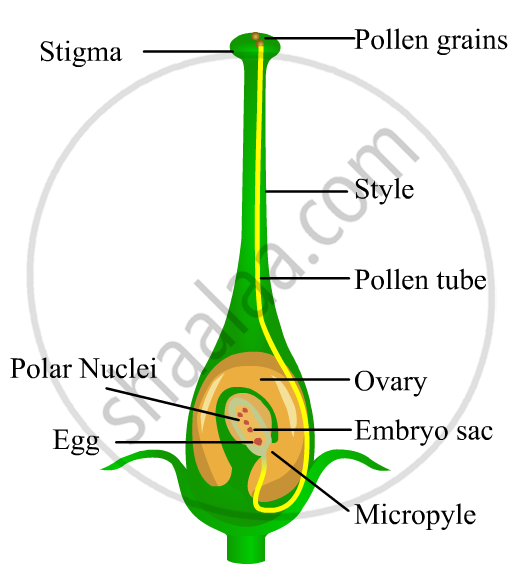
APPEARS IN
RELATED QUESTIONS
A student has to perform the experiment "To identify the different parts of an embryo of a dicot seed." Select from the following an appropriate group of seeds:
(a) Pea, gram, wheat
(b) Red kidney bean, maize, gram
(c) Maize, wheat, red kidney bean
(d) Red kidney bean, pea, gram
Name the swollen lower part of the carpel.
Fill in the following blank with suitable word :
The name of the structure in the flower in which the male gamete is formed is...........
Explain the terms 'cross-pollination'?
Describe the process of fertilisation in a flower with the help of labelled diagrams.
In what ways is fertilisation in a plant similar to fertilisation in a human?
Write the events involved in the sexual reproduction of a flowering plant.
Discuss the first event and write the types.
In a flowering plant, archesporium gives rise to ______.
Give any two examples of agents of pollination.
What is the function of calyx?
