Advertisements
Advertisements
Question
Identify A, B, C and D in the given diagram and write their names.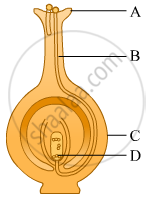
Advertisements
Solution
A - Stigma
Function: It is a sticky surface where the pollen lands and later germinates.
B - Pollen tube
Function: It carries the pollen to the egg cell for fertilisation.
C - Ovary
Function: It is the female reproductive part of the flower containing ovules.
D - Egg cell
Function: It forms the zygote after fertilisation.
APPEARS IN
RELATED QUESTIONS
State the name of the functional unit concerned with sexual reproduction.
Name the male part of the flower.
Fill in the following blank with suitable word :
The name of the structure in the flower in which the male gamete is formed is...........
| When an insect sits on the flower of a plant then somene particles A present in the top of little stalks in the flower attach to its body hair. When this insect now sits on the flower of another similar plant, then particles A attached to the hair of insect are put on the top of a flask-shaped organ at the centre of flower. The particle A grows a long tube B from the top of flask-shaped organ through which C moves down and reaches the bottom part of flask-shaped organ. Here C fuses with the nucleus of D contained in structure E. The fusion of C and D forms a new cell F which grows and develops into a seed of the plant. |
- What are particles A? What is the process of transferring A from one flower to another flower of similar plant by the insect known as?
- What is the name of tube B?
- What is C which moves down through the tube B?
- Name D and E.
- What is F?
What is a flower ? Draw a neat labelled diagram showing the L.S. of a typical flower.
Find the odd-one out, giving reason:
Anther, pollen grain, ovule male gamete
Describe an activity to demonstrate phototropism.
The essential parts of a flower are ______.
In a flowering plant, archesporium gives rise to ______.
In a bisexual flower inspite of the young stamens being removed artificially, the flower produces fruit. Provide a suitable explanation for the above situation.
