Advertisements
Advertisements
प्रश्न
Identify A, B, C and D in the given diagram and write their names.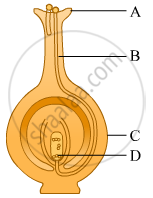
Advertisements
उत्तर
A - Stigma
Function: It is a sticky surface where the pollen lands and later germinates.
B - Pollen tube
Function: It carries the pollen to the egg cell for fertilisation.
C - Ovary
Function: It is the female reproductive part of the flower containing ovules.
D - Egg cell
Function: It forms the zygote after fertilisation.
APPEARS IN
संबंधित प्रश्न
Where is the male gamete formed in flowering plants?
Give some examples of different modes of fertilisation in nature?
In tobacco plant, the male gametes have 24 chromosomes.
What is the number of chromosomes in the female gamete?
The correct sequence of reproductive stages occurring in flowering plants is ______.
The students of a class were asked by the teacher to study the different parts of an embryo of an angiosperm. Given below are the essential steps for the experiment :
A. Soak the seeds in plain water and keep them overnight.
B. Cut open the soaked seed and observe its different parts.
C. Take some healthy seeds in a petri-dish.
D. Drain the excess water, cover the seeds with a wet cotton cloth and leave them as it is for a day.
The correct sequence of these steps is
(a) C, A, D, B
(b) C, D, A, B
(c) A, C, D, B
(d) A, C, B, D
Sketch the labelled diagram.
Flower with its sexual reproductive organs.
Fill in the blanks and rewrite the completed statements:
Lymph flows in _______________ direction.
In which of the following manner the arrangement of megaspores in a tetrad is observed in angiosperms?
Sketch and label the essential and accessory whorls of flower.
Explain the post fertilization changes that occur in the ovary of a flower.
