Advertisements
Advertisements
प्रश्न
Explain the terms 'cross-pollination'?
Advertisements
उत्तर
In cross pollination, pollens from the anther of one flower are transferred to the stigma of the another flower of another plant but of the same species.
APPEARS IN
संबंधित प्रश्न
Name and differentiate between the two modes of pollination in flowering plants.
How does the process of fertilisation take place in flowers?
Fill in the following blank with suitable word :
Flowering plants reproduce by ...........method of reproduction.
What type of plants reproduce by sexual reproduction method?
Draw a neat diagram of a flower showing its various parts. In this diagram mark stem, receptacle, sepals, petals, stamen and carpel.
One of the following occurs in the reproductive system of flowering plants as well as that of humans. This is :
(a) vas deferens
(b) anther
(c) ovary
(d) style
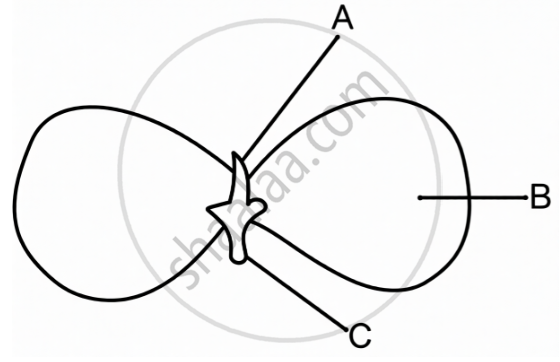
In the figure given alongside, the parts marked A, B and C are sequentially:
Fill in the blank by selecting suitable word:
A flower bearing only male or female parts is known as __________ flower.
Multiple choice question. Tick (✓) the correct choice:
The male gamete is present inside the which germinates.
- the style
- the stigma
- the anther
- the ovary
Fill in the blank by selecting suitable word:
Transfer of pollen grains from the anther to the stigma is known as______________.
Find the odd one out:
What does germination mean?
Write the functions of sepals
Which of the following are the chemical components of the wall of pollen tube?
Conidia are formed endogenously while zoospores are formed endogenously.
Length of pollen tube depends on the distance between ______
Give reason for the following:
Fertilization cannot take place in flowers if pollination does not occur.
State the number of sets of chromosomes present in a zygote.
Sketch and label the essential and accessory whorls of flower.
