Advertisements
Advertisements
प्रश्न
Find the odd one out:
पर्याय
Stigma
Anther
Style
Ovary
Advertisements
उत्तर
Anther
APPEARS IN
संबंधित प्रश्न
Name the parts A, B and C shown in the diagram and write their functions.

How does fertilisation occur in flowers? Name the parts of the flower that develop into (i) seed, and (ii) fruit after fertilisation.

(i) Name the part marked 'A' in the diagram.
(ii) How dose 'A' reachese part 'B'?
(iii) State the importance of the part 'C'.
(iv) What happens to the part marked 'D' after fertilisation is over?
Mention the changes a flower undergoes after fertilisation.
State the function of flowers in the flowering plants.
A flower may have either male or female reproductive parts. Such a flower is called ______.
Draw a neat sketch of the carpel of a flower. Mark in it stigma, style and ovary.
What is made in ovary of a flower?
Give some examples of different modes of fertilisation in nature?
What type of plants reproduce by sexual reproduction method?
In tobacco plant, the male gametes have 24 chromosomes.
What is the number of chromosomes in the zygote?
How does pollination occur?
The length of pollen tube depends on the distance between :
(a) pollen grain and upper surface of stigma
(b) pollen grain on upper surface of stigma and ovule
(c) pollen grain in anther and upper surface of stigma
(d) upper surface of stigma and lower part of style
Which of the following statements are true for sexual reproduction in flowering plants?
(i) it requires two types of gametes
(ii) fertilisation is a compulsory event
(iii) it always results in the formation of zygote
(iv) offsprings formed are clones
(a) (i) and (iv)
(b) (i), (ii) and (iv)
(c) (i), (ii) and (iii)
(d) (ii), (iii) and (iv)
The correct sequence of reproductive stages occurring in flowering plants is ______.
The part of a seed which grows and develops into root on germination is :
(a) cotyledon
(b) plumule
(c) follicle
(d) radicle
In what ways is fertilisation in a plant similar to fertilisation in a human?
Put a tick mark (✓) against the correct alternative in the following statement
Reproductive whorls of a flower are:
Fill in the blank by selecting suitable word:
A flower that bears both the male and the female parts is known as __________ flower.
You have to perform the experiment, "To identify the different parts of an embryo of a gram seed." Describe the procedure that you would follow.
In the figure, the parts marked A, B and C are sequentially:

(A) Plumule, Radicle and Cotyledon
(B) Radicle, Plumule and Cotyledon
(C) Plumule, Cotyledon and Radicle
(D) Radicle, Cotyledon and Plumule
Draw a diagram of a pistil showing pollen tube growth into the ovule and label the following:
Pollen grain, male gamete, female gamete, ovary.
What is phototropism?
Fill in the blanks and rewrite the completed statements:
Lymph flows in _______________ direction.
What is cleistogamy? Write one advantage and one disadvantage of it, to the plant.
Calyx : Sepals : : Corolla : ________________
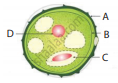
Identify the parts A, B, C, and D?
The seed that contains the future plant is called the ______
Length of pollen tube depends on the distance between ______
Complete the table
| Carly x | ______ | ______ |
| ______ | petal | attract insects |
| Androecium | ______ | Male reproductive part |
| ______ | ______ | Female reproductive part. |
Double fertilization is exhibited by ______
Double fertilization means ______.
Give any two examples of agents of pollination.
The figure below shows the concept of double fertilization. Complete the flow chart showing the progress at each step:

Consider the following three flowers namely X, Y and Z. Which flower(s) would develop into a fruit?
| Flower X | Flower Y | Flower Z |
 |
 |
 |
Explain the post fertilization changes that occur in the ovary of a flower.
The number of pollen sacs in a dithecous anther is ______.
