Advertisements
Advertisements
प्रश्न
Calyx : Sepals : : Corolla : ________________
Advertisements
उत्तर
Calyx : Sepals : : Corolla : Petals
APPEARS IN
संबंधित प्रश्न
Match the following:
| Column A | Column B |
| (i) Stigma | (a) Neuron |
| (ii) Pepsin | (b) Carpel |
| (iii) Dendrites | (c) Protein |
| (d) Stamen |
Name the parts A, B and C shown in the diagram and write their functions.

What is pollination?
A student identified the various parts of an embryo of a gram seed and listed them as given below :
(I) Testa
(II) Plumule
(III) Radicle
(IV) Cotyledon
(V) Tegmen
Out of these the actual parts of the embryo are :
(A) I, II, III
(B) II, III, IV
(C) III, IV, V
(D) II, IV, V
Explain what you understand by sexual reproduction.
Name the part made up of the stigma, style and ovary.
What is the name of female part of a flower?
What is the name of female organ of a flower (other than carpel)?
Where is the male gamete formed in flowering plants?
Fill in the following blank with suitable word :
Flowering plants reproduce by ...........method of reproduction.
Fill in the following blank with suitable word :
The name of the structure in the flower in which the male gamete is formed is...........
What is made in ovary of a flower?
Give some examples of different modes of fertilisation in nature?
What changes take place in the flower after fertilisation which lead to the formation of seeds and fruit?
The flask-shaped organ A at the centre of a flower is surrounded by a number of little stalks B having swollen tops which lie just inside the ring of petals.
(a) Name A. What are the various parts of A?
(b) Which part of A contains gametes?
(c) Name B. What is the swollen top of B known as?
(d) What does the swollen top of b contain?
(e) Out of A and B, which one is (i) male part, and (ii) female part of the flower?
What is a flower ? Draw a neat labelled diagram showing the L.S. of a typical flower.
Multiple choice question. Tick (✓) the correct choice:
Unisexual flowers are found in
- mulberry
- mustard
- pea
- sunflower
Draw a labelled diagram of a bisexual flower.
You have to perform the experiment, "To identify the different parts of an embryo of a gram seed." Describe the procedure that you would follow.
The students of a class were asked by the teacher to study the different parts of an embryo of an angiosperm. Given below are the essential steps for the experiment :
A. Soak the seeds in plain water and keep them overnight.
B. Cut open the soaked seed and observe its different parts.
C. Take some healthy seeds in a petri-dish.
D. Drain the excess water, cover the seeds with a wet cotton cloth and leave them as it is for a day.
The correct sequence of these steps is
(a) C, A, D, B
(b) C, D, A, B
(c) A, C, D, B
(d) A, C, B, D
Identify A, B, C and D in the given diagram and write their names.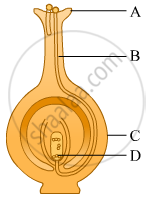
Write the names of male and female reproductive parts of a flower.
What is meant by pollination?
Find the odd one out:
Accessory whorls : Calyx and corolla : : essential whorls : ______________
Pollen grains from anther are transferred to the stigma.
Give scientific reason.
Fertilization in plants is called double fertilization.
Write the events involved in the sexual reproduction of a flowering plant.
Discuss the first event and write the types.
Where does the endothecium layer of anther lobes is present?
Antipodal cells are present towards the ______ in an anatropous ovule.
The 3-celled egg apparatus at the micropylar end comprises of ______
The flower of the Hibiscus plant is ______
Variations occur as a result of ______
Length of pollen tube depends on the distance between ______
In a bisexual flower inspite of the young stamens being removed artificially, the flower produces fruit. Provide a suitable explanation for the above situation.
Trace the path a male gamete takes to fertilise a female gamete after being released from the penis.
Consider the following three flowers namely X, Y and Z. Which flower(s) would develop into a fruit?
| Flower X | Flower Y | Flower Z |
 |
 |
 |
- Assertion: Primary endosperm nucleus is diploid.
- Reason: It is the product of double fertilisation.
