Advertisements
Advertisements
प्रश्न
Explain sexual reproduction in plants.
Advertisements
उत्तर
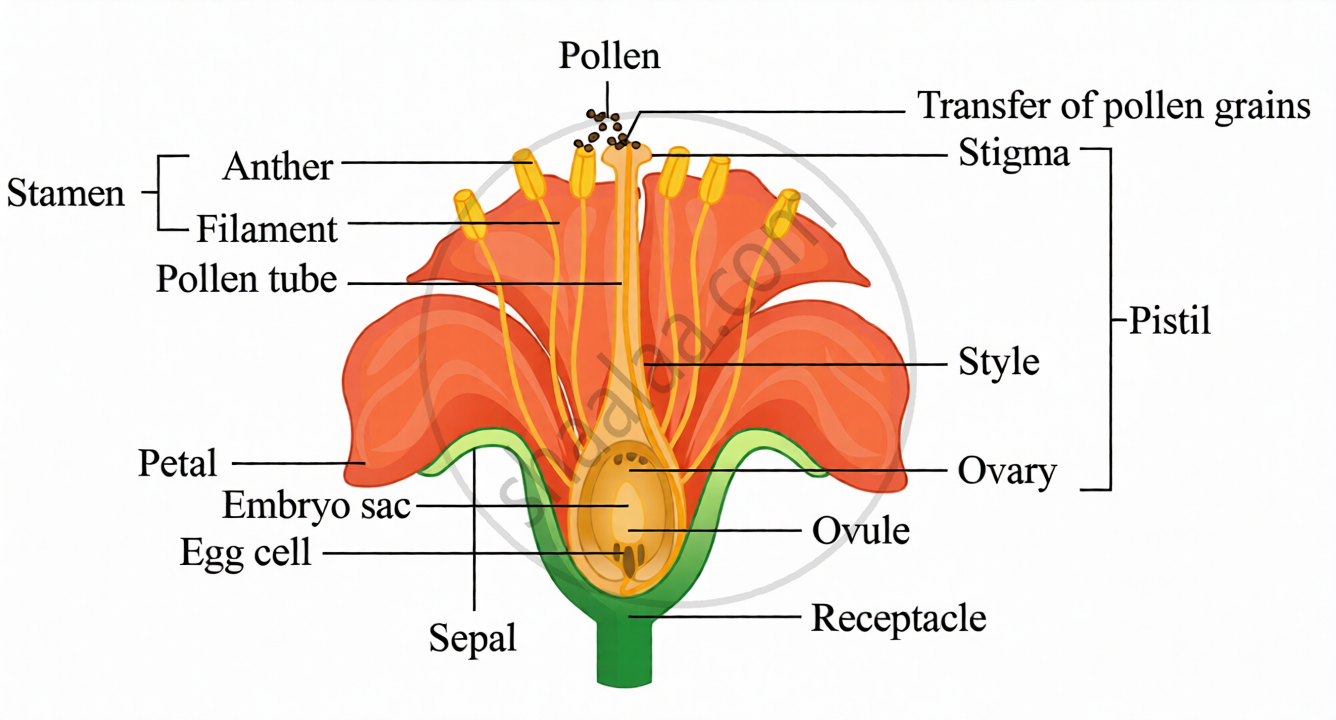
- In sexually reproducing plants, flowers function as the reproductive organs.
- In flowers, the male organ is the stamen and the female organ is the carpel.
- Flowers which have both the male and female organs, i.e. stamens and carpels, are called bisexual flowers, whereas flowers which have either male or female organs are called unisexual.
- Male gametes, called pollen grains, are produced by stamens, and carpels produce female gametes, called ovules or egg cells, inside ovaries.
- Fertilization takes place in the ovule where the egg cell and pollen grain fuse.
- This fertilized egg cell later develops into an embryo and the entire ovule gets converted into a seed.
- Under favourable conditions, the seed germinates to give rise to a new plant.
APPEARS IN
संबंधित प्रश्न
How does fertilisation occur in flowers? Name the parts of the flower that develop into (i) seed, and (ii) fruit after fertilisation.
State significance of pollination.
"The chromosomal number of the sexually producing parents and their offspring is the same." Justify this statement.
Mention the changes a flower undergoes after fertilisation.
Name the part made up of the stigma, style and ovary.
Where is the male gamete formed in flowering plants?
Fill in the following blank with suitable word :
The ovary of a flower becomes ....... after fertilisation.
What is made in anther of a flower?
The flask-shaped organ A at the centre of a flower is surrounded by a number of little stalks B having swollen tops which lie just inside the ring of petals.
(a) Name A. What are the various parts of A?
(b) Which part of A contains gametes?
(c) Name B. What is the swollen top of B known as?
(d) What does the swollen top of b contain?
(e) Out of A and B, which one is (i) male part, and (ii) female part of the flower?
| When an insect sits on the flower of a plant then somene particles A present in the top of little stalks in the flower attach to its body hair. When this insect now sits on the flower of another similar plant, then particles A attached to the hair of insect are put on the top of a flask-shaped organ at the centre of flower. The particle A grows a long tube B from the top of flask-shaped organ through which C moves down and reaches the bottom part of flask-shaped organ. Here C fuses with the nucleus of D contained in structure E. The fusion of C and D forms a new cell F which grows and develops into a seed of the plant. |
- What are particles A? What is the process of transferring A from one flower to another flower of similar plant by the insect known as?
- What is the name of tube B?
- What is C which moves down through the tube B?
- Name D and E.
- What is F?
Put a tick mark (✓) against the correct alternative in the following statement
Pollen is produced in the:
Fill in the blanks:
A carpel consists of ________ , ________ and ________.
State whether the following statement is true (T) or false (F):
Flowers which possess stamens and carpel are called unisexual.
(a) Identify A, B and C in the given diagram and write their functions.
(b) Mention the role of gamete and zygote in sexually reproducing organisms.
Describe an activity to demonstrate phototropism.
List any two differences between pollination and fertilization.
Which of the following is not an unisexual flower?
a) Coconut
b) Papaya
c) Gulmohor
d) Maize
Fill in the blanks and rewrite the completed statements:
Lymph flows in _______________ direction.
Mention pollination types.
A student is observing the temporary mount of a leaf peel under a microscope. Draw a labelled diagram of the structure of stomata as seen under the microscope
Answer the following question.
List two agents of pollination?
Find an odd one out.
Define.
Inflorescence
Write the functions of sepals
Give scientific reason.
Flower is a structural unit of sexual reproduction in plants.
Explain the sexual reproduction process in plants with a diagram.
The male reproductive part of a flower is ______.
Write the events involved in the sexual reproduction of a flowering plant.
Discuss the first event and write the types.
The anther wall consists of four wall layers where ______
Which of the following are the chemical components of the wall of pollen tube?
Gloriosa superba exhibits ______.
Flowers showing ornithophily show few characteristic like ______.
In a flowering plant, archesporium gives rise to ______.
What would be the number of chromosomes in the cells of the aleurone layer in a plant species with 8 chromosomes in its synergids?
The figure below shows the concept of double fertilization. Complete the flow chart showing the progress at each step:

Triple fusion involves ______.
- Assertion: Primary endosperm nucleus is diploid.
- Reason: It is the product of double fertilisation.
In male reproductive whorl of a flower the archesporial cells are formed by ______.
