Advertisements
Advertisements
प्रश्न
Prepare a slogan for campaign against female foeticide.
Advertisements
उत्तर
Avoid female foeticide, save girl child
APPEARS IN
संबंधित प्रश्न
Match the following:
| Column A | Column B |
| (i) Stigma | (a) Neuron |
| (ii) Pepsin | (b) Carpel |
| (iii) Dendrites | (c) Protein |
| (d) Stamen |
What is pollination?
You are asked by your teacher to study the different parts of an embryo of a gram seed. Given below are the steps to be followed for the experiment:
I. Soak the gram seeds in plain water and keep them overnight.
II. Cut open a soaked seed and observe its different parts.
III. Take some dry gram seeds in a petri dish.
IV. Drain the excess water.
V. Cover the soaked seeds with a wet cotton cloth and leave them for a day.
The correct sequence of these steps is :
(A) III, I, V, IV, II
(B) III, I, II, IV, V
(C) III, IV, V, I, II
(D) III, I, IV, V, II
Write the names of those parts of a flower which serve the same function as the following do in the animals :
(i) testis,
(ii) sperm,
(iii) ovary,
(iv) egg
How is the process of pollination different from fertilization?
What are the reproductive organs in a flower?
Fill in the following blank with suitable word :
The male organ of reproduction in the flower is the.......... .
Explain the terms 'self pollination'
Which of the following statements are true for sexual reproduction in flowering plants?
(i) it requires two types of gametes
(ii) fertilisation is a compulsory event
(iii) it always results in the formation of zygote
(iv) offsprings formed are clones
(a) (i) and (iv)
(b) (i), (ii) and (iv)
(c) (i), (ii) and (iii)
(d) (ii), (iii) and (iv)
In what ways is fertilisation in a plant similar to fertilisation in a human?
Fill in the blank by selecting suitable word:
A flower bearing only male or female parts is known as __________ flower.
Multiple choice question. Tick (✓) the correct choice:
The male gamete is present inside the which germinates.
- the style
- the stigma
- the anther
- the ovary
State whether the following statement is true (T) or false (F):
Flowers which possess stamens and carpel are called unisexual.
You have to perform the experiment, "To identify the different parts of an embryo of a gram seed." Describe the procedure that you would follow.
The students of a class were asked by the teacher to study the different parts of an embryo of an angiosperm. Given below are the essential steps for the experiment :
A. Soak the seeds in plain water and keep them overnight.
B. Cut open the soaked seed and observe its different parts.
C. Take some healthy seeds in a petri-dish.
D. Drain the excess water, cover the seeds with a wet cotton cloth and leave them as it is for a day.
The correct sequence of these steps is
(a) C, A, D, B
(b) C, D, A, B
(c) A, C, D, B
(d) A, C, B, D
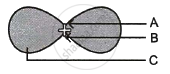
In the figure, the parts marked A, B and C are sequentially:

(A) Plumule, Radicle and Cotyledon
(B) Radicle, Plumule and Cotyledon
(C) Plumule, Cotyledon and Radicle
(D) Radicle, Cotyledon and Plumule
“Cell division is a type of reproduction in unicellular organism.” Justify.
Which of the following is not an unisexual flower?
a) Coconut
b) Papaya
c) Gulmohor
d) Maize
Mention pollination types.
Draw a diagram of the longitudinal section of a flower and label the following parts.
Differentiate between self-pollination and cross-pollination.
Define.
Inflorescence
Draw a neat and labelled diagram.
Double fertilization in angiosperms
Where does the endothecium layer of anther lobes is present?
In which of the following manner the arrangement of megaspores in a tetrad is observed in angiosperms?
How many middle layers are generally present in the wall of the anther lobes?
Which type of development is observed in male gametophytes of plants?
Variations occur as a result of ______
Give reason for the following:
Fertilization cannot take place in flowers if pollination does not occur.
State the number of sets of chromosomes present in a zygote.
Double fertilization is exhibited by ______
Sketch and label the essential and accessory whorls of flower.
Give any two examples of agents of pollination.
What are the agents for pollination?
Sexual maturation of reproductive tissues and organs are necessary link for reproduction. Elucidate.
Given below is a diagram of a germinating seed. Label the parts that:
- gives rise to future shoot.
- gives rise to future root system.
- stores food.
In male reproductive whorl of a flower the archesporial cells are formed by ______.
The number of pollen sacs in a dithecous anther is ______.
