Advertisements
Advertisements
प्रश्न
Pollen grains are formed by _________ division in locules of anthers.
पर्याय
meiosis
mitosis
amitosis
binary
Advertisements
उत्तर
Pollen grains are formed by meiosis division in locules of anthers.
APPEARS IN
संबंधित प्रश्न
A student has to perform the experiment "To identify the different parts of an embryo of a dicot seed." Select from the following an appropriate group of seeds:
(a) Pea, gram, wheat
(b) Red kidney bean, maize, gram
(c) Maize, wheat, red kidney bean
(d) Red kidney bean, pea, gram
"The chromosomal number of the sexually producing parents and their offspring is the same." Justify this statement.
Give one example of a unisexual flower.
The reproductive part of a plant is the ______.
Where are a plant's sex organs located?
What is the function of a flower?
Fill in the following blank with suitable word :
The ovary of a flower becomes ....... after fertilisation.
Draw a neat sketch of the stamen of a flower. Mark in it filament and anther.
Give some examples of different modes of fertilisation in nature?
Which of the following statements are true for sexual reproduction in flowering plants?
(i) it requires two types of gametes
(ii) fertilisation is a compulsory event
(iii) it always results in the formation of zygote
(iv) offsprings formed are clones
(a) (i) and (iv)
(b) (i), (ii) and (iv)
(c) (i), (ii) and (iii)
(d) (ii), (iii) and (iv)
| When an insect sits on the flower of a plant then somene particles A present in the top of little stalks in the flower attach to its body hair. When this insect now sits on the flower of another similar plant, then particles A attached to the hair of insect are put on the top of a flask-shaped organ at the centre of flower. The particle A grows a long tube B from the top of flask-shaped organ through which C moves down and reaches the bottom part of flask-shaped organ. Here C fuses with the nucleus of D contained in structure E. The fusion of C and D forms a new cell F which grows and develops into a seed of the plant. |
- What are particles A? What is the process of transferring A from one flower to another flower of similar plant by the insect known as?
- What is the name of tube B?
- What is C which moves down through the tube B?
- Name D and E.
- What is F?
Multiple choice question. Tick (✓) the correct choice:
Unisexual flowers are found in
- mulberry
- mustard
- pea
- sunflower
Mention the function of Anther.
Identify A, B, C and D in the given diagram and write their names.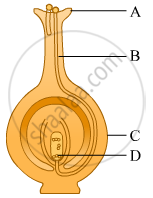
A student is asked to study the different parts of an embryo of pea seeds. Given below are the essential steps for the experiment :
(I) Soak the pea seeds in plain water and keep them overnight.
(II) Cut open the soaked seed and observe its different parts.
(III) Take some pea seeds in a petri dish.
(IV) Drain the excess water. Cover the seeds with a wet cotton cloth and leave them as it is for a day.
The correct sequence of these steps is
(A) III, I, IV, II
(B) III, IV, I, II
(C) III, I, II, IV
(D) III, II, I, IV
(a) Identify A, B and C in the given diagram and write their functions.
(b) Mention the role of gamete and zygote in sexually reproducing organisms.
Draw a diagram of the longitudinal section of a flower and label on it sepal, petal, ovary and stigma.
Fill in the blanks and rewrite the completed statements:
Lymph flows in _______________ direction.
What is meant by pollination?
__________ is present in unisexual flower.
The male reproductive part of a flower is ______.
Match the following
| 1. | Petal | Opuntia |
| 2. | Fern | Chrysanthemum |
| 3. | Phylloclade | Attracts insect |
| 4. | Hooks | Spore |
| 5. | Sucker | Bignonia |
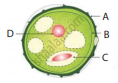
Identify the parts A, B, C, and D?
In which of the following manner the arrangement of megaspores in a tetrad is observed in angiosperms?
Which type of development is observed in male gametophytes of plants?
Conidia are formed endogenously while zoospores are formed endogenously.
The flower of the Hibiscus plant is ______
The process of release of eggs from the ovary is called ______
In human beings, fertilization occurs in the ______
Length of pollen tube depends on the distance between ______
Complete the table
| Carly x | ______ | ______ |
| ______ | petal | attract insects |
| Androecium | ______ | Male reproductive part |
| ______ | ______ | Female reproductive part. |
Give reason for the following:
Fertilization cannot take place in flowers if pollination does not occur.
Is the chromosome number of zygote, embryonal cells and adult of a particular organism always constant? How is the constancy maintained in these three stages?
Sketch and label the essential and accessory whorls of flower.
Sexual maturation of reproductive tissues and organs are necessary link for reproduction. Elucidate.
Type of sexual reproduction is ______.
Explain the post fertilization changes that occur in the ovary of a flower.
The number of pollen sacs in a dithecous anther is ______.
