Advertisements
Advertisements
Question
Pollen grains are formed by _________ division in locules of anthers.
Options
meiosis
mitosis
amitosis
binary
Advertisements
Solution
Pollen grains are formed by meiosis division in locules of anthers.
APPEARS IN
RELATED QUESTIONS

(i) Name the part marked 'A' in the diagram.
(ii) How dose 'A' reachese part 'B'?
(iii) State the importance of the part 'C'.
(iv) What happens to the part marked 'D' after fertilisation is over?
Name and differentiate between the two modes of pollination in flowering plants.
Give one example of a unisexual flower.
The fusion of male and female gametes is termed as ______.
The reproductive part of a plant is the ______.
Name the swollen lower part of the carpel.
Where are the pollen grains produced?
What is the name of female organ of a flower (other than carpel)?
Fill in the following blank with suitable word :
The ovary of a flower becomes ....... after fertilisation.
Fill in the following blank with suitable word :
The name of the structure in the flower in which the male gamete is formed is...........
Fill in the following blank with suitable word :
The term used to refer to the transfer of pollen from the stamen of one flower to the carpel of another flower of the same species is...........
Explain the terms 'cross-pollination'?
Name the part of a seed which contains stored food.
In tobacco plant, the male gametes have 24 chromosomes.
What is the number of chromosomes in the zygote?
Describe the process of fertilisation in a flower with the help of labelled diagrams.
Draw a neat diagram of a flower showing its various parts. In this diagram mark stem, receptacle, sepals, petals, stamen and carpel.
Multiple choice question. Tick (✓) the correct choice:
The male gamete is present inside the which germinates.
- the style
- the stigma
- the anther
- the ovary
Fill in the blanks:
A stamen consists of ______ and ________.
Give one example each of unisexual and bisexual flowers. Differentiate between the two types of pollination that occur in flowers. What happens when a pollen lands on a suitable stigma? Write about the events that occur till the seed formation in the ovary.
Identify A, B, C and D in the given diagram and write their names.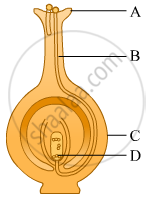
Prepare a slogan for campaign against female foeticide.
__________ is present in unisexual flower.
Bisexual : Hibiscus : : Unisexual : ___________
Explain the sexual reproduction process in plants with a diagram.
Observe the figure below. Write functions of the labelled parts.

The male reproductive part of a flower is ______.
Write the events involved in the sexual reproduction of a flowering plant.
a. Discuss the first event and write the types.
b. Mention the advantages and the disadvantages of that event.
In which of the following manner the arrangement of megaspores in a tetrad is observed in angiosperms?
Antipodal cells are present towards the ______ in an anatropous ovule.
How many middle layers are generally present in the wall of the anther lobes?
Which out of the following processes does not lead to the formation of clones.
Complete the table
| Carly x | ______ | ______ |
| ______ | petal | attract insects |
| Androecium | ______ | Male reproductive part |
| ______ | ______ | Female reproductive part. |
In a bisexual flower inspite of the young stamens being removed artificially, the flower produces fruit. Provide a suitable explanation for the above situation.
Where is the zygote located in the flower after fertilization?
Double fertilization means ______.
What is the function of calyx?
Triple fusion involves ______.
Sexual maturation of reproductive tissues and organs are necessary link for reproduction. Elucidate.
