Advertisements
Advertisements
प्रश्न
Pollen grains are formed by _________ division in locules of anthers.
विकल्प
meiosis
mitosis
amitosis
binary
Advertisements
उत्तर
Pollen grains are formed by meiosis division in locules of anthers.
APPEARS IN
संबंधित प्रश्न
Match the following:
| Column A | Column B |
| (i) Stigma | (a) Neuron |
| (ii) Pepsin | (b) Carpel |
| (iii) Dendrites | (c) Protein |
| (d) Stamen |
A student was asked to observe and identify the various parts of an embryo of a red kidney bean seed. He identified the parts and listed them as under:
I. Tegmen
II. Testa
III. Cotyledon
IV. Radicle
V. Plumule
The correctly identified parts among these are
(A) I, II and III
(B) II, III and IV
(C) III, IV and V
(D) I, III, IV and V
How does fertilisation occur in flowers? Name the parts of the flower that develop into (i) seed, and (ii) fruit after fertilisation.
In the following diagram showing the structure of embryo of a dicot seed, what are the parts marked I, II and III sequentially?

Sketch the reproductive parts of a flower.
The reproductive part of a plant is the ______.
State the name of the functional unit concerned with sexual reproduction.
Fill in the following blank with suitable word :
The male organ of reproduction in the flower is the.......... .
Fill in the following blank with suitable word :
The name of the structure in the flower in which the male gamete is formed is...........
Draw a neat sketch of the carpel of a flower. Mark in it stigma, style and ovary.
What is made in ovary of a flower?
Explain the term 'fertilisation'.
What is meant by ‘unisexual flowers’?
Describe the process of fertilisation in a flower with the help of labelled diagrams.
Which of the following is the correct sequence of events of sexual reproduction in a flower?
(a) pollination, fertilisation, seed, embryo
(b) seed, embryo, fertilisation, pollination
(c) pollination, fertilisation, embryo, seed
(d) embryo, seed, pollination, fertilisation
Fill in the blank by selecting suitable word:
A flower that bears both the male and the female parts is known as __________ flower.
What is a flower ? Draw a neat labelled diagram showing the L.S. of a typical flower.
Multiple choice question. Tick (✓) the correct choice:
The male gamete is present inside the which germinates.
- the style
- the stigma
- the anther
- the ovary
Fill in the blanks:
A carpel consists of ________ , ________ and ________.
Write one main difference between asexual and sexual mode of reproduction. Which species is likely to have comparatively better chances of survival – the one reproducing asexually or the one reproducing sexually? Give reason to justify your answer.
Draw a diagram of the longitudinal section of a flower exhibiting germination of pollen on stigma and label (i) ovary, (ii) male germ-cell, (iii) female germ-cell and (iv) ovule on it.
Identify A, B, C and D in the given diagram and write their names.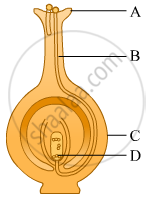
Explain the process of fertilisation in flowers.
(a) Identify A, B and C in the given diagram and write their functions.
(b) Mention the role of gamete and zygote in sexually reproducing organisms.
“Cell division is a type of reproduction in unicellular organism.” Justify.
Distinguish between unisexual and bisexual flowers giving one example of each. Draw a diagram showing process of germination of pollen grains on stigma and label the following parts:
(a) Female germ cell
(b) Male germ cell
(c) Ovary
Draw a diagram of the longitudinal section of a flower and label on it sepal, petal, ovary and stigma.
Write the names of male and female reproductive parts of a flower.
Describe an activity to demonstrate phototropism.
Differentiate between self-pollination and cross-pollination.
Pollen grains from anther are transferred to the stigma.
Write the events involved in the sexual reproduction of a flowering plant.
Discuss the first event and write the types.
Antipodal cells are present towards the ______ in an anatropous ovule.
Flowers showing ornithophily show few characteristic like ______.
Pollen grains are produced by ______
Complete the table
| Carly x | ______ | ______ |
| ______ | petal | attract insects |
| Androecium | ______ | Male reproductive part |
| ______ | ______ | Female reproductive part. |
The ovaries of different flowers may contain ______.
What are the agents for pollination?
- Assertion: Primary endosperm nucleus is diploid.
- Reason: It is the product of double fertilisation.
