Advertisements
Advertisements
प्रश्न
Explain the sexual reproduction process in plants with a diagram.
Advertisements
उत्तर
Sexual reproduction in plants:
- A flower is the functional unit of sexual reproduction in plants.
- The androecium and gynoecium are the male and female parts of the flower respectively.
- The female reproductive organ of a flower which gives rise to egg or female gamete is known as carpel. Ovary present at the base of the carpel contains ovules that undergo meiosis to form embryo sac.
- Stamen is the male reproductive part of a flower which gives rise to male gametes.
- In sexual reproduction of plants, pollination is a major step, which involves the transfer of pollen grains on the stigma of female flower.
- Stigma becomes sticky during pollination.
- The pollen grain germinates over the stigma and gives rise to the pollen tube.
- Pollen tube carries two male gametes which are released near egg cells present in the embryo sac.
- One male gamete fuses with a female gamete giving rise to zygote. The second male gamete fuses with two polar nuclei giving rise to endosperm. This is called as double fertilization.
- Zygote develops into embryo and endosperm serves as a nutritive tissue for the growing embryo.
- After fertilization, the ovule develops into seed and ovary into fruit. Seeds fall upon the ground and can develop into a new plant under favourable conditions.

APPEARS IN
संबंधित प्रश्न
Match the following:
| Column A | Column B |
| (i) Stigma | (a) Neuron |
| (ii) Pepsin | (b) Carpel |
| (iii) Dendrites | (c) Protein |
| (d) Stamen |
State significance of pollination.
A flower may have either male or female reproductive parts. Such a flower is called ______.
How does the process of fertilisation take place in flowers?
Name the male part of the flower.
Where are a plant's sex organs located?
What is the name of female organ of a flower (other than carpel)?
Fill in the following blank with suitable word :
Pollen grains contain ............ gametes of a plant.
Fill in the following blank with suitable word :
The ovary of a flower becomes ....... after fertilisation.
Fill in the following blank with suitable word :
Flowering plants reproduce by ...........method of reproduction.
What is made in anther of a flower?
How is the process of pollination different from fertilization?
Describe the process of fertilisation in a flower with the help of labelled diagrams.
Draw a neat diagram of a flower showing its various parts. In this diagram mark stem, receptacle, sepals, petals, stamen and carpel.
Which of the following is the correct sequence of events of sexual reproduction in a flower?
(a) pollination, fertilisation, seed, embryo
(b) seed, embryo, fertilisation, pollination
(c) pollination, fertilisation, embryo, seed
(d) embryo, seed, pollination, fertilisation
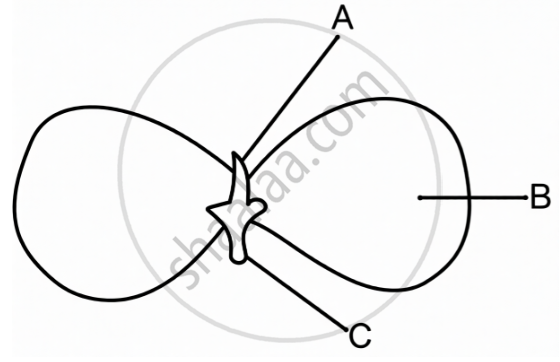
In the figure given alongside, the parts marked A, B and C are sequentially:
The part of a seed which grows and develops into root on germination is :
(a) cotyledon
(b) plumule
(c) follicle
(d) radicle
The flask-shaped organ A at the centre of a flower is surrounded by a number of little stalks B having swollen tops which lie just inside the ring of petals.
(a) Name A. What are the various parts of A?
(b) Which part of A contains gametes?
(c) Name B. What is the swollen top of B known as?
(d) What does the swollen top of b contain?
(e) Out of A and B, which one is (i) male part, and (ii) female part of the flower?
Put a tick mark (✓) against the correct alternative in the following statement
Pollen is produced in the:
Fill in the blank by selecting suitable word:
A flower bearing only male or female parts is known as __________ flower.
Multiple choice question. Tick (✓) the correct choice:
Unisexual flowers are found in
- mulberry
- mustard
- pea
- sunflower
State whether the following statement is true (T) or false (F):
Stamens make egg cells.
What part is played by stamens and carpels in reproduction?
(a) Identify A, B and C in the given diagram and write their functions.
(b) Mention the role of gamete and zygote in sexually reproducing organisms.
In the figure, the parts marked A, B and C are sequentially:

(A) Plumule, Radicle and Cotyledon
(B) Radicle, Plumule and Cotyledon
(C) Plumule, Cotyledon and Radicle
(D) Radicle, Cotyledon and Plumule
What is phototropism?
Identify the odd. Stigma, Style, Pollen, Ovary.
Sketch the labelled diagram.
Flower with its sexual reproductive organs.
A student is observing the temporary mount of a leaf peel under a microscope. Draw a labelled diagram of the structure of stomata as seen under the microscope
Generally, in a pollen tube, which of the following moves to the tip of the tube?
Identify the female gametophyte in angiosperms.
State the number of sets of chromosomes present in a zygote.
Double fertilization is essential for formation of ______.
Sketch and label the essential and accessory whorls of flower.
In flowering plants, the pollen grains are transferred to stigma by pollination but the female germ cells are present in the ovary.
Explain with the help of a labelled diagram (only concerned parts), how the male germ cell reaches the ovary.
The pollen tube usually enters the embryo sac ______.
In male reproductive whorl of a flower the archesporial cells are formed by ______.
The number of pollen sacs in a dithecous anther is ______.
