Advertisements
Advertisements
प्रश्न
In a bisexual flower inspite of the young stamens being removed artificially, the flower produces fruit. Provide a suitable explanation for the above situation.
Advertisements
उत्तर
A bisexual flower possesses both the male reproductive parts, stamens and female reproductive part, pistil. If the stamens are removed, pistil is present in the flower. On cross pollination followed by successful fertilisation, the ovary of the pistil would have developed into a fruit.
APPEARS IN
संबंधित प्रश्न
A student was asked to observe and identify the various parts of an embryo of a red kidney bean seed. He identified the parts and listed them as under:
I. Tegmen
II. Testa
III. Cotyledon
IV. Radicle
V. Plumule
The correctly identified parts among these are
(A) I, II and III
(B) II, III and IV
(C) III, IV and V
(D) I, III, IV and V
"The chromosomal number of the sexually producing parents and their offspring is the same." Justify this statement.
You are asked by your teacher to study the different parts of an embryo of a gram seed. Given below are the steps to be followed for the experiment:
I. Soak the gram seeds in plain water and keep them overnight.
II. Cut open a soaked seed and observe its different parts.
III. Take some dry gram seeds in a petri dish.
IV. Drain the excess water.
V. Cover the soaked seeds with a wet cotton cloth and leave them for a day.
The correct sequence of these steps is :
(A) III, I, V, IV, II
(B) III, I, II, IV, V
(C) III, IV, V, I, II
(D) III, I, IV, V, II
Where is the male gamete formed in flowering plants?
Explain the term 'fertilisation'.
Name the part of a seed which grows into shoot.
Describe the process of fertilisation in a flower with the help of labelled diagrams.
Identify A, B, C and D in the given diagram and write their names.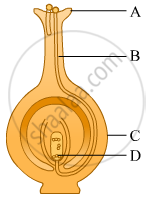
In the figure, the parts marked A, B and C are sequentially:

(A) Plumule, Radicle and Cotyledon
(B) Radicle, Plumule and Cotyledon
(C) Plumule, Cotyledon and Radicle
(D) Radicle, Cotyledon and Plumule
Draw a diagram of a pistil showing pollen tube growth into the ovule and label the following:
Pollen grain, male gamete, female gamete, ovary.
Answer the following question.
List two agents of pollination?
Find an odd one out.
Pollen tube reaches the embryo sac via style.
Pollen grains from anther are transferred to the stigma.
Distinguish between self-pollination and cross-pollination.
Draw a neat and labelled diagram.
Double fertilization in angiosperms
Observe the figure below. Write functions of the labelled parts.

Match the following
| 1. | Petal | Opuntia |
| 2. | Fern | Chrysanthemum |
| 3. | Phylloclade | Attracts insect |
| 4. | Hooks | Spore |
| 5. | Sucker | Bignonia |
Draw the diagram of a flower and label the four whorls. Write the names of gamete producing organs in the flower.
Double fertilization is exhibited by ______
