Advertisements
Advertisements
Question
In a bisexual flower inspite of the young stamens being removed artificially, the flower produces fruit. Provide a suitable explanation for the above situation.
Advertisements
Solution
A bisexual flower possesses both the male reproductive parts, stamens and female reproductive part, pistil. If the stamens are removed, pistil is present in the flower. On cross pollination followed by successful fertilisation, the ovary of the pistil would have developed into a fruit.
APPEARS IN
RELATED QUESTIONS
A student has to perform the experiment "To identify the different parts of an embryo of a dicot seed." Select from the following an appropriate group of seeds:
(a) Pea, gram, wheat
(b) Red kidney bean, maize, gram
(c) Maize, wheat, red kidney bean
(d) Red kidney bean, pea, gram
Name the swollen lower part of the carpel.
What are the reproductive organs in a flower?
Where is the male gamete formed in flowering plants?
Fill in the following blank with suitable word :
The female organ of reproduction in the flower is the...........
Draw a neat sketch of the carpel of a flower. Mark in it stigma, style and ovary.
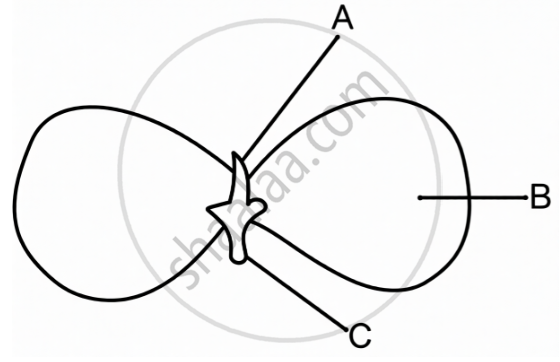
In the figure given alongside, the parts marked A, B and C are sequentially:
The flask-shaped organ A at the centre of a flower is surrounded by a number of little stalks B having swollen tops which lie just inside the ring of petals.
(a) Name A. What are the various parts of A?
(b) Which part of A contains gametes?
(c) Name B. What is the swollen top of B known as?
(d) What does the swollen top of b contain?
(e) Out of A and B, which one is (i) male part, and (ii) female part of the flower?
| When an insect sits on the flower of a plant then somene particles A present in the top of little stalks in the flower attach to its body hair. When this insect now sits on the flower of another similar plant, then particles A attached to the hair of insect are put on the top of a flask-shaped organ at the centre of flower. The particle A grows a long tube B from the top of flask-shaped organ through which C moves down and reaches the bottom part of flask-shaped organ. Here C fuses with the nucleus of D contained in structure E. The fusion of C and D forms a new cell F which grows and develops into a seed of the plant. |
- What are particles A? What is the process of transferring A from one flower to another flower of similar plant by the insect known as?
- What is the name of tube B?
- What is C which moves down through the tube B?
- Name D and E.
- What is F?
Put a tick mark (✓) against the correct alternative in the following statement
Pollen is produced in the:
Multiple choice question. Tick (✓) the correct choice:
The male gamete is present inside the which germinates.
- the style
- the stigma
- the anther
- the ovary
Fill in the blanks:
A stamen consists of ______ and ________.
Fill in the blank:
Seeds are formed from________.
Mention the function of Flower.
Write the names of male and female reproductive parts of a flower.
Calyx : Sepals : : Corolla : ________________
Bisexual : Hibiscus : : Unisexual : ___________
The 3-celled egg apparatus at the micropylar end comprises of ______
The seed that contains the future plant is called the ______
What is the function of calyx?
