Advertisements
Online Mock Tests
Chapters
2: Acids, Bases and Salts
3: Metals and Non-metals
4: Carbon and its Compounds
5: Periodic Classification of Elements
6: Life Processes
7: Control and Coordination
▶ 8: How do Organisms Reproduce?
9: Heredity and Evolution
10: Light – Reflection and Refraction
11: The Human Eye and the Colourful World
12: Electricity
13: Magnetic Effects of Electric Current
14: Sources of Energy
15: Our Environment
16: Management of Natural Resources
![NCERT Exemplar solutions for साइंस इग्ज़ेम्प्लार [अंग्रेजी] कक्षा १० chapter 8 - How do Organisms Reproduce? - Shaalaa.com](/images/science-exemplar-class-10_6:01ae6a390cce47ffa3714532a2454be5.png "NCERT Exemplar solutions for साइंस इग्ज़ेम्प्लार [अंग्रेजी] कक्षा १० chapter 8 - How do Organisms Reproduce?")
Advertisements
Solutions for Chapter 8: How do Organisms Reproduce?
Below listed, you can find solutions for Chapter 8 of CBSE, Karnataka Board NCERT Exemplar for साइंस इग्ज़ेम्प्लार [अंग्रेजी] कक्षा १०.
NCERT Exemplar solutions for साइंस इग्ज़ेम्प्लार [अंग्रेजी] कक्षा १० 8 How do Organisms Reproduce? Multiple Choice Questions [Pages 65 - 69]
In the list of organisms given below, those that reproduce by the asexual method are
- banana
- yeast
- dog
- Amoeba
(ii) and (iv)
(i), (iii) and (iv)
(i) and (iv)
(ii), (iii) and (iv)
In a flower, the parts that produce male and female gametes (germ cells) are
stamen and anther
filament and stigma
anther and ovary
stamen and style
Which of the following is the correct sequence of events of sexual reproduction in a flower?
pollination, fertilisation, seedling, embryo
seedling, embryo, fertilisation, pollination
pollination, fertilisation, embryo, seedling
embryo, seedling, pollination, fertilisation
Offspring formed by asexual method of reproduction have greater similarity among themselves because
- asexual reproduction involves only one parent
- asexual reproduction does not involve gametes
- asexual reproduction occurs before sexual reproduction
- asexual reproduction occurs after sexual reproduction
(i) and (ii)
(i) and (iii)
(ii) and (iv)
(iii) and (iv)
Characters transmitted from parents to offspring are present in
cytoplasm
ribosome
Golgi bodies
genes
Characters that are transmitted from parents to offspring during reproduction show
only similarities with parents
only variations with parents
both similarities and variations with parents
neither similarities nor variations
A feature of reproduction that is common to Amoeba, Spirogyra and Yeast is that
they reproduce asexually
they are all unicellular
they reproduce only sexually
they are all multi-cellular
In Spirogyra, asexual reproduction takes place by
breaking up of filaments into smaller bits
division of a cell into two cells
division of a cell into many cells
formation of young cells from older cells.
The ability of a cell to divide into several cells during reproduction in Plasmodium is called
budding
reduction division
binary fission
multiple fission
The correct sequence of reproductive stages seen in flowering plants is
gametes, zygote, embryo, seedling
zygote, gametes, embryo, seedling
seedling, embryo, zygote, gametes
gametes, embryo, zygote, seedling
The number of chromosomes in parents and offsprings of a particular species undergoing sexual reproduction remain constant due to:
doubling of chromosomes after zygote formation.
the halving of chromosomes during gamete formation.
doubling of chromosomes after gamete formation.
the halving of chromosomes after gamete formation.
In Rhizopus, tubular thread-like structures bearing sporangia at their tips are called
filaments
hyphae
rhizoids
roots
Vegetative propagation refers to formation of new plants from
stem, roots and flowers
stem, roots and leaves
stem, flowers and fruits
stem, leaves and flowers
Factors responsible for the rapid spread of bread mould on slices of bread are
- large number of spores
- availability of moisture and nutrients in bread
- presence of tubular branched hyphae
- formation of round shaped sporangia
(i) and (iii)
(ii) and (iv)
(i) and (ii)
(iii) and (iv)
Length of pollen tube depends on the distance between
pollen grain and upper surface of stigma
pollen grain on upper surface of stigma and ovule
pollen grain in anther and upper surface of stigma
upper surface of stigma and lower part of style
Which of the following statements are true for flowers?
- Flowers are always bisexual
- They are the sexual reproductive organs
- They are produced in all groups of plants
- After fertilisation they give rise to fruits
(i) and (iv)
(ii) and (iii)
(i) and (iii)
(ii) and (iv)
Which among the following statements are true for unisexual flowers?
- They possess both stamen and pistil
- They possess either stamen or pistil
- They exhibit cross pollination
- Unisexual flowers possessing only stamens cannot produce fruits
(i) and (iv)
(ii), (iii) and (iv)
(iii) and (iv)
(i), (iii) and (iv)
Which among the following statements are true for sexual reproduction in flowering plants?
- It requires two types of gametes
- Fertilisation is a compulsory event
- It always results in formation of zygote
- Offspring formed are clones
(i) and (iv)
(i), (ii) and (iv)
(i), (ii) and (iii)
(i), (ii) and (iv)
In Figure, the parts A, B and C are sequentially
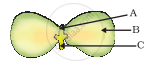
cotyledon, plumule and radicle
plumule, radicle and cotyledon
plumule, cotyledon and radicle
radicle, cotyledon and plumule
Offspring formed as a result of sexual reproduction exhibit more variations because
sexual reproduction is a lengthy process
genetic material comes from two parents of the same species
genetic material comes from two parents of different species
genetic material comes from many parents
Reproduction is essential for living organisms in order to
keep the individual organism alive
fulfill their energy requirement
maintain growth
continue the species generation after generation
During adolescence, several changes occur in the human body. Mark one change associated with sexual maturation in boys
loss of milk teeth
increase in height
cracking of voice
weight gain
In human females, an event that reflects onset of reproductive phase is
growth of body
changes in hair pattern
change in voice
menstruation
In human males, the testes lie in the scrotum, because it helps in the
process of mating
formation of sperm
easy transfer of gametes
all the above
Which among the following is not the function of testes at puberty?
- formation of germ cells
- secretion of testosterone
- development of placenta
- secretion of estrogen
(i) and (ii)
(ii) and (iii)
(iii) and (iv)
(i) and (iv)
The correct sequence of organs in the male reproductive system for transport of sperms is
testis → vasdeferens → urethra
testis → ureter → urethra
testis → urethra → ureter
testis → vasdeferens → ureter
Which among the following diseases is not sexually transmitted?
Syphilis
Hepatitis
HIV - AIDS
Gonorrhoea
NCERT Exemplar solutions for साइंस इग्ज़ेम्प्लार [अंग्रेजी] कक्षा १० 8 How do Organisms Reproduce? Short Answer Questions [Pages 69 - 71]
In a bisexual flower inspite of the young stamens being removed artificially, the flower produces fruit. Provide a suitable explanation for the above situation.
Can you consider cell division as a type of reproduction in unicellular organism? Give one reason.
What is a clone? Why do offsprings formed by asexual reproduction exhibit remarkable similarity?
Explain how, offspring and parents of organisms reproducing sexually have the same number of chromosomes?
Colonies of yeast fail to multiply in water, but multiply in sugar solution. Give one reason for this.
Why does bread mould grow profusely on a moist slice of bread rather than on a dry slice of bread?
Give two reasons for the appearance of variations among the progeny formed by sexual reproduction.
Would a Planaria cut vertically into two halves regenerate into two individuals? Complete Figure D and E by indicating the regenerated regions.
 |
 |
 |
 |
 |
| A | B | C | D | E |
From the internet, gather information about the chromosome numbers of five animals and five plants. Correlate the number with the size of organism and answer the following questions.
- Do larger organisms have more number of chromosomes/cells?
- Can organism with fewer chromosomes reproduce more easily than organisms with more number of chromosomes?
- More the number of chromosomes/cells greater is the DNA content. Justify.
In tobacco plant, the male gametes have twenty four chromosomes.
What is the number of chromosomes in the female gamete?
What is the number of chromosomes in the zygote?
Give reason for the following:
Fertilization cannot take place in flowers if pollination does not occur.
Is the chromosome number of zygote, embryonal cells and adult of a particular organism always constant? How is the constancy maintained in these three stages?
Where is the zygote located in the flower after fertilization?
Reproduction is linked to stability of population of a species. Justify the statement.
How are general growth and sexual maturation different from each other?
Trace the path of sperm during ejaculation and mention the gland and their functions associated with the male reproductive system.
What changes are observed in the uterus if fertilisation does not occur?
What changes are observed in the uterus subsequent to the implantation of a young embryo?
What are the benefits of using mechanical barriers during sexual act?
In the given Figure label the parts and mention their functions
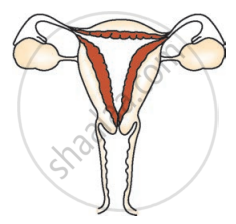
- Production of egg
- Site of fertilisation
- Site of implantation
- Entry of the sperms
What would be the ratio of chromosome number between an egg and its zygote? How is the sperm genetically different from the egg?
NCERT Exemplar solutions for साइंस इग्ज़ेम्प्लार [अंग्रेजी] कक्षा १० 8 How do Organisms Reproduce? Long Answer Questions [Pages 71 - 72]
Why are budding, fragmentation and regeneration all considered as asexual types of reproduction? With neat diagrams explain the process of regeneration in Planaria.
Write two points of difference between asexual and sexual types of reproduction. Describe why variations are observed in the offspring formed by sexual reproduction.
Distinguish between pollination and fertilisation. Mention the site and product of fertilisation in a flower.
Draw a neat, labelled diagram of a pistil showing pollen tube growth and its entry into the ovule.
Distinguish between a gamete and zygote. Explain their roles in sexual reproduction.
Draw the diagram of a flower and label the four whorls. Write the names of gamete producing organs in the flower.
What is placenta? Mention its role during pregnancy?
What are various ways to avoid pregnancy? Elaborate any one method.
How does fertilisation take place? Fertilisation occurs once in a month. Comment.
Reproduction is essentially a phenomenon that is not for survival of an individual but for the stability of a species. Justify.
Describe sexually transmitted diseases and mention the ways to prevent them.
Solutions for 8: How do Organisms Reproduce?
NCERT Exemplar solutions for साइंस इग्ज़ेम्प्लार [अंग्रेजी] कक्षा १० chapter 8 - How do Organisms Reproduce?
Shaalaa.com has the CBSE, Karnataka Board Mathematics साइंस इग्ज़ेम्प्लार [अंग्रेजी] कक्षा १० CBSE, Karnataka Board solutions in a manner that help students grasp basic concepts better and faster. The detailed, step-by-step solutions will help you understand the concepts better and clarify any confusion. NCERT Exemplar solutions for Mathematics साइंस इग्ज़ेम्प्लार [अंग्रेजी] कक्षा १० CBSE, Karnataka Board 8 (How do Organisms Reproduce?) include all questions with answers and detailed explanations. This will clear students' doubts about questions and improve their application skills while preparing for board exams.
Further, we at Shaalaa.com provide such solutions so students can prepare for written exams. NCERT Exemplar textbook solutions can be a core help for self-study and provide excellent self-help guidance for students.
Concepts covered in साइंस इग्ज़ेम्प्लार [अंग्रेजी] कक्षा १० chapter 8 How do Organisms Reproduce? are .
Using NCERT Exemplar साइंस इग्ज़ेम्प्लार [अंग्रेजी] कक्षा १० solutions How do Organisms Reproduce? exercise by students is an easy way to prepare for the exams, as they involve solutions arranged chapter-wise and also page-wise. The questions involved in NCERT Exemplar Solutions are essential questions that can be asked in the final exam. Maximum CBSE, Karnataka Board साइंस इग्ज़ेम्प्लार [अंग्रेजी] कक्षा १० students prefer NCERT Exemplar Textbook Solutions to score more in exams.
Get the free view of Chapter 8, How do Organisms Reproduce? साइंस इग्ज़ेम्प्लार [अंग्रेजी] कक्षा १० additional questions for Mathematics साइंस इग्ज़ेम्प्लार [अंग्रेजी] कक्षा १० CBSE, Karnataka Board, and you can use Shaalaa.com to keep it handy for your exam preparation.
