Advertisements
Advertisements
प्रश्न
Which among the following statements are true for unisexual flowers?
- They possess both stamen and pistil
- They possess either stamen or pistil
- They exhibit cross pollination
- Unisexual flowers possessing only stamens cannot produce fruits
विकल्प
(i) and (iv)
(ii), (iii) and (iv)
(iii) and (iv)
(i), (iii) and (iv)
Advertisements
उत्तर
(ii), (iii) and (iv)
Explanation -
Flowers which possess either stamens or pistil are called unisexual flowers. These flowers are borne either on the same or different plants thus, pollen grains need to be transferred from one flower to another through agents like wind, water or animals, that is, cross pollination occurs. Since fruits develop from the ovary of the pistil, unisexual flowers with stamens only cannot bear fruits.
APPEARS IN
संबंधित प्रश्न
A student identified the various parts of an embryo of a gram seed and listed them as given below :
(I) Testa
(II) Plumule
(III) Radicle
(IV) Cotyledon
(V) Tegmen
Out of these the actual parts of the embryo are :
(A) I, II, III
(B) II, III, IV
(C) III, IV, V
(D) II, IV, V
Give one example of a unisexual flower.
The process of fusion of the male and female gametes is called ______.
Fill in the following blank with suitable word :
The.......... at the base of the carpel contains egg cells.
Name the part of a seed which grows into shoot.
What changes take place in the flower after fertilisation which lead to the formation of seeds and fruit?
The part of a seed which grows and develops into root on germination is :
(a) cotyledon
(b) plumule
(c) follicle
(d) radicle
Identify A, B, C and D in the given diagram and write their names.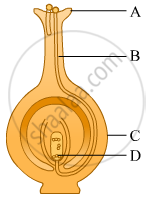
(a) Identify A, B and C in the given diagram and write their functions.
(b) Mention the role of gamete and zygote in sexually reproducing organisms.
Pollen grains from anther are transferred to the stigma.
Distinguish between self-pollination and cross-pollination.
Identify the parts A, B, C, and D?
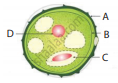
Conidia are formed endogenously while zoospores are formed endogenously.
In human beings, fertilization occurs in the ______
In a bisexual flower inspite of the young stamens being removed artificially, the flower produces fruit. Provide a suitable explanation for the above situation.
Give any two examples of agents of pollination.
Sexual maturation of reproductive tissues and organs are necessary link for reproduction. Elucidate.
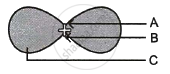
Given below is a diagram of a germinating seed. Label the parts that:
- gives rise to future shoot.
- gives rise to future root system.
- stores food.
State the post-fertilisation changes that lead to fruit formation in plants.
