Advertisements
Advertisements
Question
Which among the following statements are true for unisexual flowers?
- They possess both stamen and pistil
- They possess either stamen or pistil
- They exhibit cross pollination
- Unisexual flowers possessing only stamens cannot produce fruits
Options
(i) and (iv)
(ii), (iii) and (iv)
(iii) and (iv)
(i), (iii) and (iv)
Advertisements
Solution
(ii), (iii) and (iv)
Explanation -
Flowers which possess either stamens or pistil are called unisexual flowers. These flowers are borne either on the same or different plants thus, pollen grains need to be transferred from one flower to another through agents like wind, water or animals, that is, cross pollination occurs. Since fruits develop from the ovary of the pistil, unisexual flowers with stamens only cannot bear fruits.
APPEARS IN
RELATED QUESTIONS
Name the parts labelled as A, B, C and D in the diagram given below:-

State significance of pollination.
Explain the terms 'self pollination'
Name the part of a seed which contains stored food.
How does pollination occur?
One of the following occurs in the reproductive system of flowering plants as well as that of humans. This is :
(a) vas deferens
(b) anther
(c) ovary
(d) style
State whether the following statement is true (T) or false (F):
Flowers which possess stamens and carpel are called unisexual.
Identify A, B, C and D in the given diagram and write their names.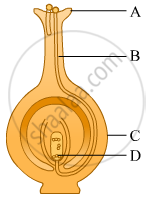
Distinguish between unisexual and bisexual flowers giving one example of each. Draw a diagram showing process of germination of pollen grains on stigma and label the following parts:
(a) Female germ cell
(b) Male germ cell
(c) Ovary
Write the names of male and female reproductive parts of a flower.
List any two differences between pollination and fertilization.
Which of the following is not an unisexual flower?
a) Coconut
b) Papaya
c) Gulmohor
d) Maize
Calyx : Sepals : : Corolla : ________________
Give scientific reason.
Flower is a structural unit of sexual reproduction in plants.
The male reproductive part of a flower is ______.
Match the following
| 1. | Petal | Opuntia |
| 2. | Fern | Chrysanthemum |
| 3. | Phylloclade | Attracts insect |
| 4. | Hooks | Spore |
| 5. | Sucker | Bignonia |
Generally, in a pollen tube, which of the following moves to the tip of the tube?
In a flowering plant, archesporium gives rise to ______.
The flower of the Hibiscus plant is ______
Is the chromosome number of zygote, embryonal cells and adult of a particular organism always constant? How is the constancy maintained in these three stages?
