Advertisements
Advertisements
प्रश्न
Name the part of a seed which grows into shoot.
Advertisements
उत्तर
The part of the seed which grows into shoot is called plumule.
APPEARS IN
संबंधित प्रश्न
Write the names of those parts of a flower which serve the same function as the following do in the animals :
(i) testis,
(ii) sperm,
(iii) ovary,
(iv) egg
Explain what you understand by sexual reproduction.
The process of fusion of the male and female gametes is called ______.
Fill in the following blank with suitable word :
The ovule becomes a .......... after fertilisation.
Fill in the following blank with suitable word :
The female organ of reproduction in the flower is the...........
The length of pollen tube depends on the distance between :
(a) pollen grain and upper surface of stigma
(b) pollen grain on upper surface of stigma and ovule
(c) pollen grain in anther and upper surface of stigma
(d) upper surface of stigma and lower part of style
The part of a seed which grows and develops into root on germination is :
(a) cotyledon
(b) plumule
(c) follicle
(d) radicle
State whether the following statement is true (T) or false (F):
Stamens make egg cells.
Identify A, B, C and D in the given diagram and write their names.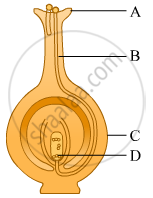
Which of the following is not an unisexual flower?
a) Coconut
b) Papaya
c) Gulmohor
d) Maize
Explain sexual reproduction in plants.
Bisexual : Hibiscus : : Unisexual : ___________
Distinguish between self-pollination and cross-pollination.
Match the following
| 1. | Petal | Opuntia |
| 2. | Fern | Chrysanthemum |
| 3. | Phylloclade | Attracts insect |
| 4. | Hooks | Spore |
| 5. | Sucker | Bignonia |
Which among the following statements are true for unisexual flowers?
- They possess both stamen and pistil
- They possess either stamen or pistil
- They exhibit cross pollination
- Unisexual flowers possessing only stamens cannot produce fruits
Sketch and label the essential and accessory whorls of flower.
In a plant flower the female whorl is ______.
What are the agents for pollination?
Name the reproductive parts of an angiosperm. Where are these parts located? Explain the structure of its male reproductive part.
